
Corrosion Resistant Alloy (CRA) Clad Steel Pipes for Sour Service and Offshore Applications
In the demanding world of oil and gas transportation, corrosion is the primary enemy of asset integrity and operational longevity. Pipelines transporting aggressive media containing hydrogen sulfide (H₂S), carbon dioxide (CO₂), chlorides, and organic acids face severe degradation risks. To combat this, the industry has turned to advanced material solutions like API 5LD clad pipe and API 5LD lined pipe. These corrosion resistant alloy (CRA) pipelines offer the perfect synergy: the structural strength of carbon steel with the corrosion barrier of high-grade alloys.
Womic Steel, leveraging its unique “Plate-to-Pipe” integration with its parent company, Womic Steel Group, stands at the forefront of this technology. With access to premium metallurgically bonded clad plates produced by Womic Steel and a state-of-the-art pipe manufacturing facility just 5km away, Womic Steel delivers high-quality bimetallic composite pipes for onshore, offshore, and subsea projects worldwide. This comprehensive guide explores the technical landscape of API 5LD corrosion resistant pipelines, focusing on manufacturing methods, material selection, and engineering standards.
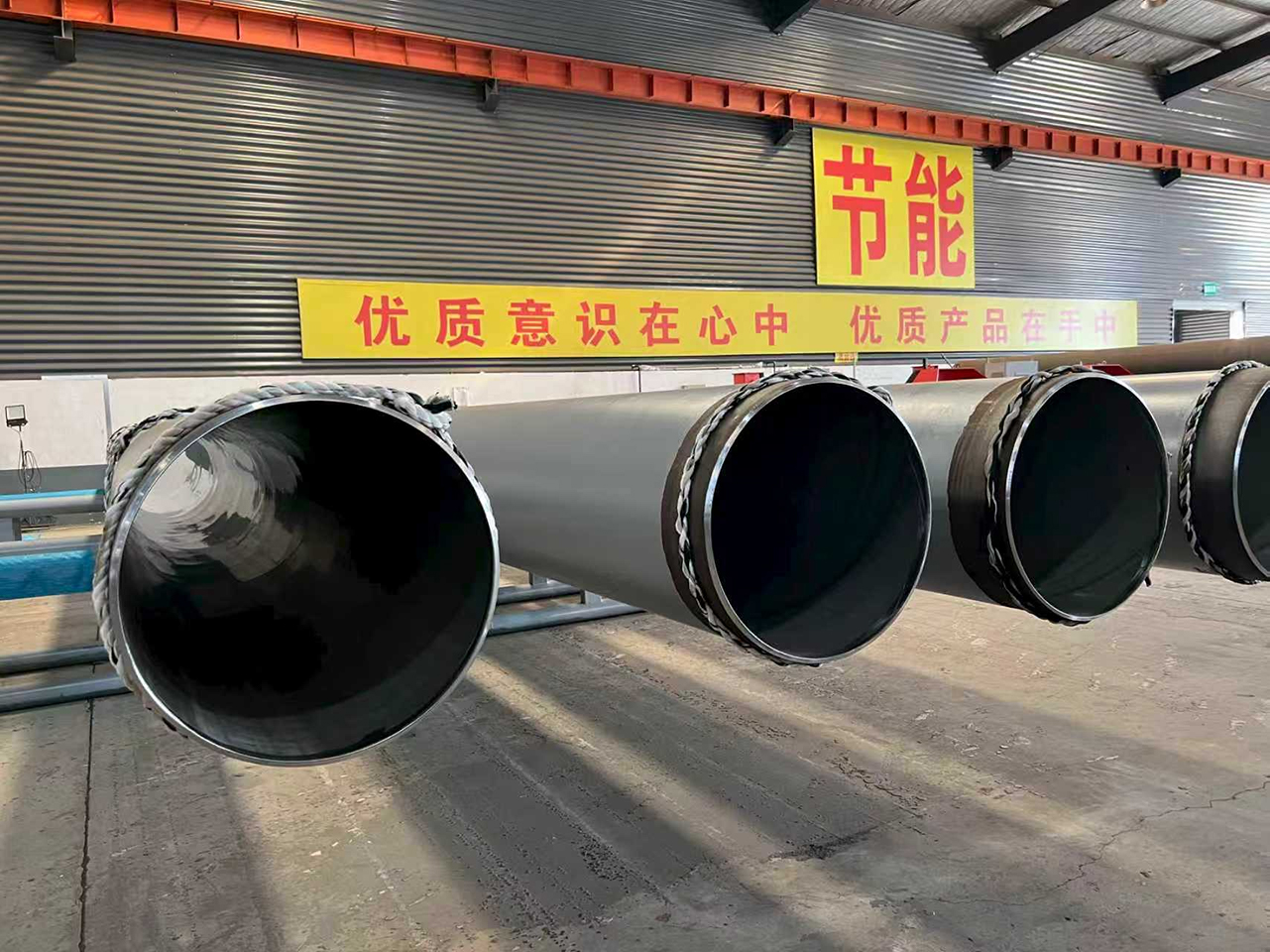
What is API 5LD Clad Pipe and Lined Pipe?
API Spec 5LD is the international standard governing CRA clad or lined steel pipe for pipeline transportation systems in the petroleum and natural gas industries. An API 5LD clad steel pipe is a composite product consisting of two distinct layers:
1. Carbon Steel Backing Pipe: Provides the mechanical strength to withstand internal pressure, external loads, and bending. It is typically manufactured to API 5L or ISO 3183 specifications (grades like X52, X60, X65).
2. Corrosion Resistant Alloy (CRA) Layer: Acts as a robust barrier against corrosive fluids. This layer can be stainless steel (e.g., 316L), duplex stainless steel (e.g., 2205), or nickel-based alloys (e.g., 625, 825).
This composite structure optimizes lifecycle costs by using expensive CRA materials only where needed—on the inner surface—while the load-bearing capacity comes from the more economical carbon steel.
Key International Standards for Corrosion Resistant Pipelines
Manufacturing and applying API 5LD clad pipe requires adherence to a matrix of complementary standards to ensure safety and reliability:
● Product Standard: API Spec 5LD (Clad/Lined Pipe), API Spec 5LC (Solid CRA Pipe).
● Base Pipe: API 5L / ISO 3183 (Line Pipe), DNV-ST-F101 (Subsea Pipeline Systems).
● Materials: ASTM A240/A312 (Stainless Steels), ASTM A790 (Duplex), ASTM B424/B444 (Nickel Alloys), NACE MR0175/ISO 15156 (Sour Service).
● Design & Fabrication: ASME B31.4 (Liquid Pipelines), ASME B31.8 (Gas Pipelines), DNV-ST-F101, NORSOK M-601 (Welding).
● Coating: ISO 21809 series (External Coatings).
● Quality & Documentation: EN 10204 (Inspection Documents), EN ISO 9712 (NDT Personnel).
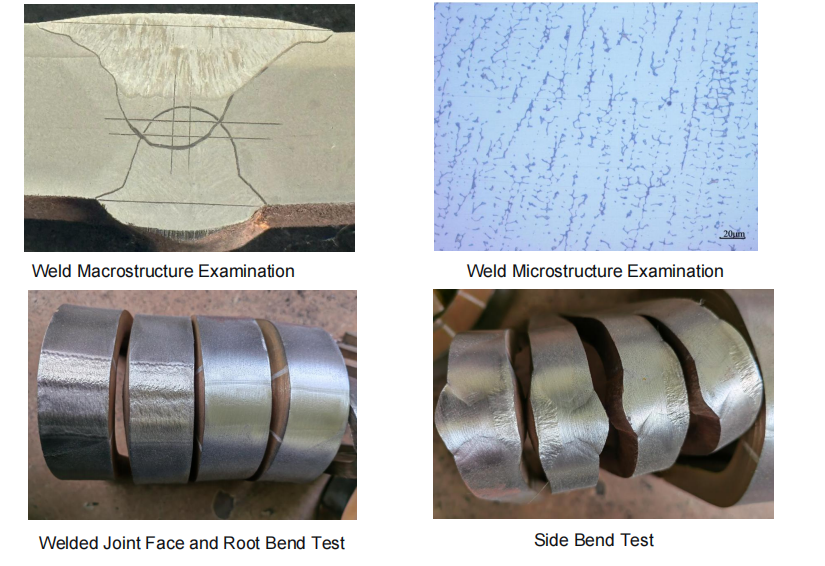
Manufacturing Technologies: Mechanical, Weld Overlay & Metallurgical Clad
The performance of a bimetallic composite pipe is heavily influenced by its manufacturing method. There are three primary technologies used globally, each with distinct characteristics in bonding strength, production efficiency, and cost.
1. Mechanically Lined Pipe (MLP)
Mechanically lined pipe is produced by inserting a thin-walled CRA liner into a carbon steel host pipe and then applying hydraulic or mechanical expansion to create an interference fit.
● Process: A CRA pipe (e.g., 316L) is inserted into an API 5L carbon steel pipe. High pressure is applied internally, expanding the liner and pressing it tightly against the inner wall of the host pipe.
● End Sealing: The pipe ends require special treatment, such as welding a CRA ring or creating a mechanical lock, to prevent liner retraction and to provide a corrosion barrier at the girth weld.
● Characteristics:
1. Pros: Relatively high production efficiency and lower initial cost for certain sizes.
2. Cons: Lower bonding strength compared to metallurgical methods. Liner stability under external pressure or bending (e.g., reel-lay installation) is a critical concern requiring verification per DNV-RP-F104. The end sealing process can affect the uniformity of the pipe bevel, potentially impacting field welding efficiency and quality. The overall composite performance of the entire pipe is lower than metallurgically bonded pipe.
2. Weld Overlay Clad Pipe
● Weld overlay clad pipe is manufactured by depositing a CRA layer directly onto the internal surface of a carbon steel pipe using advanced welding techniques.
● Process: Hot Wire TIG (Tungsten Inert Gas) welding, GMAW, or SAW is used to apply a corrosion resistant alloy such as 2205, 316L, or 625 onto the inner wall of a seamless or welded carbon steel pipe. Multiple passes are often required to achieve the desired thickness.
● Characteristics:
1. Pros: Provides strong metallurgical bonding between the substrate and the CRA layer. Excellent for small-diameter pipes, fittings (elbows, tees), and complex geometries where other methods are impractical.
2. Cons: Production efficiency is low, and manufacturing cycles are longer. The process is labor-intensive and has a higher production cost due to significant welding consumable usage. The overlay surface is typically rougher than a rolled plate and may require finishing.
Womic Steel utilizes advanced Hot Wire TIG technology for weld overlay applications, producing pipes and fittings typically in the size range of Φ430 mm to Φ1422 mm, with CRA materials including 2205, 304, 316, 625, and 825.
3. Metallurgically Bonded Clad Plate Pipe (The Womic Steel Advantage)
Metallurgically bonded clad plate pipe is considered the most advanced and reliable form of bimetallic composite pipe. This is the core competency of Womic Steel, enabled by its close integration
● Process:
1. Clad Plate Production: We produces high-quality clad plates through a hot rolling process. A CRA plate (e.g., 625, 316L, 2205) and a carbon steel plate are bonded together under high temperature and pressure, creating a permanent metallurgical bond at the atomic level.
2. Pipe Forming: These premium clad plates are then transferred to Womic Steel and formed into pipes using advanced JCOE technology.
3. Welding: The longitudinal seam is welded using a combination of SAW for the carbon steel backing and Hot Wire TIG for the CRA layer, ensuring the corrosion barrier’s continuity.
Characteristics:
1. Highest Bonding Strength: The metallurgical bond offers the strongest resistance to delamination under extreme pressure, temperature, and mechanical stress.
2. Superior Pipe Geometry: The JCOE process, starting from a flat plate, results in excellent dimensional accuracy, roundness, and bevel uniformity. This significantly improves field girth welding efficiency and installation quality.
3. High Efficiency & Cost-Effectiveness: For large-diameter pipelines, this method offers high production efficiency, shorter delivery times, and a competitive total cost compared to solid CRA or even some weld overlay solutions for large volumes.
4. Excellent Surface Finish: The inner CRA surface is smooth, promoting better flow and reducing the risk of deposits.
Womic Steel specializes in metallurgically bonded clad plate pipes, leveraging the “Plate-to-Pipe” synergy. This ensures complete material traceability, priority access to high-quality clad plates, and seamless technical collaboration between the plate mill and the pipe mill. This integration is a key differentiator, allowing for rapid development and delivery of customized solutions for demanding projects.
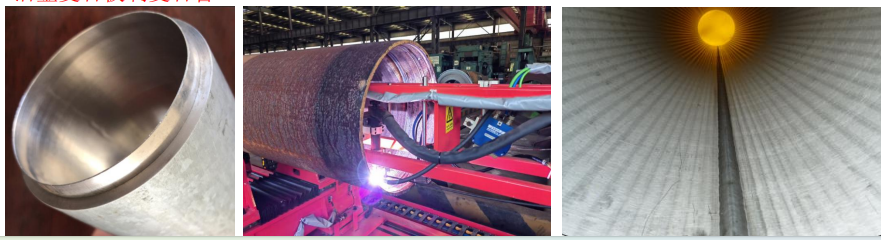
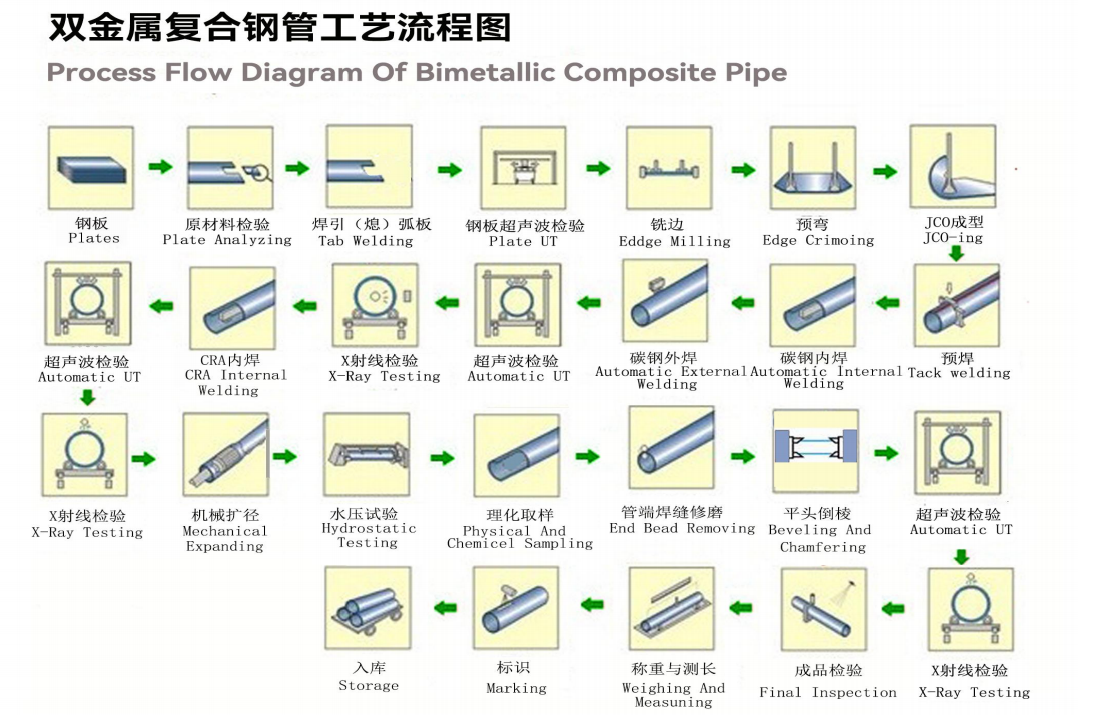
Manufacturing Process of API 5LD Clad Steel Pipe
The manufacturing process of API 5LD clad pipe requires strict control to ensure bond integrity, corrosion resistance, and mechanical performance.
Typical production route for metallurgically bonded clad pipe includes:
1. CRA clad plate production using explosion bonding or hot roll bonding
2. Plate forming using UOE or JCOE pipe forming technology
3. Submerged arc welding of longitudinal seams
4. Heat treatment and pipe reshaping
5. Non-destructive testing including ultrasonic and radiographic inspection
6. Bond shear testing and flattening testing
7. Hydrostatic pressure testing
8. Dimensional inspection and final verification
For mechanically lined pipe production, the typical process includes:
1. Manufacturing API 5L carbon steel backing pipe
2. Inserting a thin CRA liner into the pipe
3. Mechanical expansion or hydraulic expansion to create interference fit
4. CRA end locking or CRA ring installation
5. Liner stability testing and wrinkle inspection
6. Hydrostatic testing and geometry inspection
These processes ensure that API 5LD clad steel pipe and API 5LD lined pipe meet strict oil and gas pipeline specifications.
Material Selection and Application Scenarios
Selecting the right CRA material is critical for long-term performance. The table below provides a quick guide based on common service conditions for API 5LD clad pipes.
| Service Scenario | Recommended CRA Material | Applicable Standards | Typical Size Range (DN) |
| Onshore Sour Gas Gathering (H₂S/CO₂) | 316L, 317L Stainless Steel | API 5LD + API 5L PSL2, NACE MR0175 | 100 – 600 |
| Seawater Injection & Produced Water | 2205 Duplex, 2507 Super Duplex | API 5LD, NORSOK M-650, DNV-ST-F101 | 150 – 600 |
| Deepwater Subsea Pipelines (High Pressure) | Alloy 625, Alloy 825 (Clad) | API 5LD, DNV-ST-F101, DNV-RP-F104 | 200 – 500 |
| Multiphase with Organic Acids & High Chlorides | 904L, 6Mo (S31254), Alloy 825 | API 5LD, NACE MR0175 | 100 – 400 |
| High-Temperature Sour Gas & Condensate | Alloy 625 (Lined or Clad) | API 5LD, NACE MR0175 | 50 – 300 |
*Note: For extremely aggressive environments or where maximum uptime is critical, solid CRA pipes per API 5LC (e.g., Alloy 625, C-276) may be specified.*
Quality Control, Inspection, and Documentation
The integrity of API 5LD corrosion resistant pipelines is ensured through a rigorous Inspection and Test Plan (ITP). Key activities include:
● Raw Material Verification: Chemical analysis and mechanical testing of both base metal and CRA layer per relevant ASTM and API standards. Sour service compliance includes hardness testing and SSC/HIC testing per NACE TM0177/TM0284.
●In-Process & NDT:
1. Bond Integrity: For clad pipes, 100% ultrasonic testing of the bond interface, supplemented by destructive shear, flattening, and reverse flattening tests on samples.
2. Weld Inspection: 100% ultrasonic and radiographic inspection of the longitudinal seam weld.
3. Dimensional Checks: Verification of OD, WT, ovality, and straightness per API 5L.
● Final Testing:
1. Hydrostatic Testing: Each pipe is pressure-tested to validate its strength and seal integrity.
2. PMI (Positive Material Identification): Verification of the CRA layer chemistry on finished pipes.
3. External Coating Inspection: DFT (Dry Film Thickness), adhesion, and holiday detection per ISO 21809.
● Documentation: All test results are compiled into comprehensive data books, typically certified to EN 10204 Type 3.1 or 3.2, ensuring full traceability from the melt shop to the final pipe.
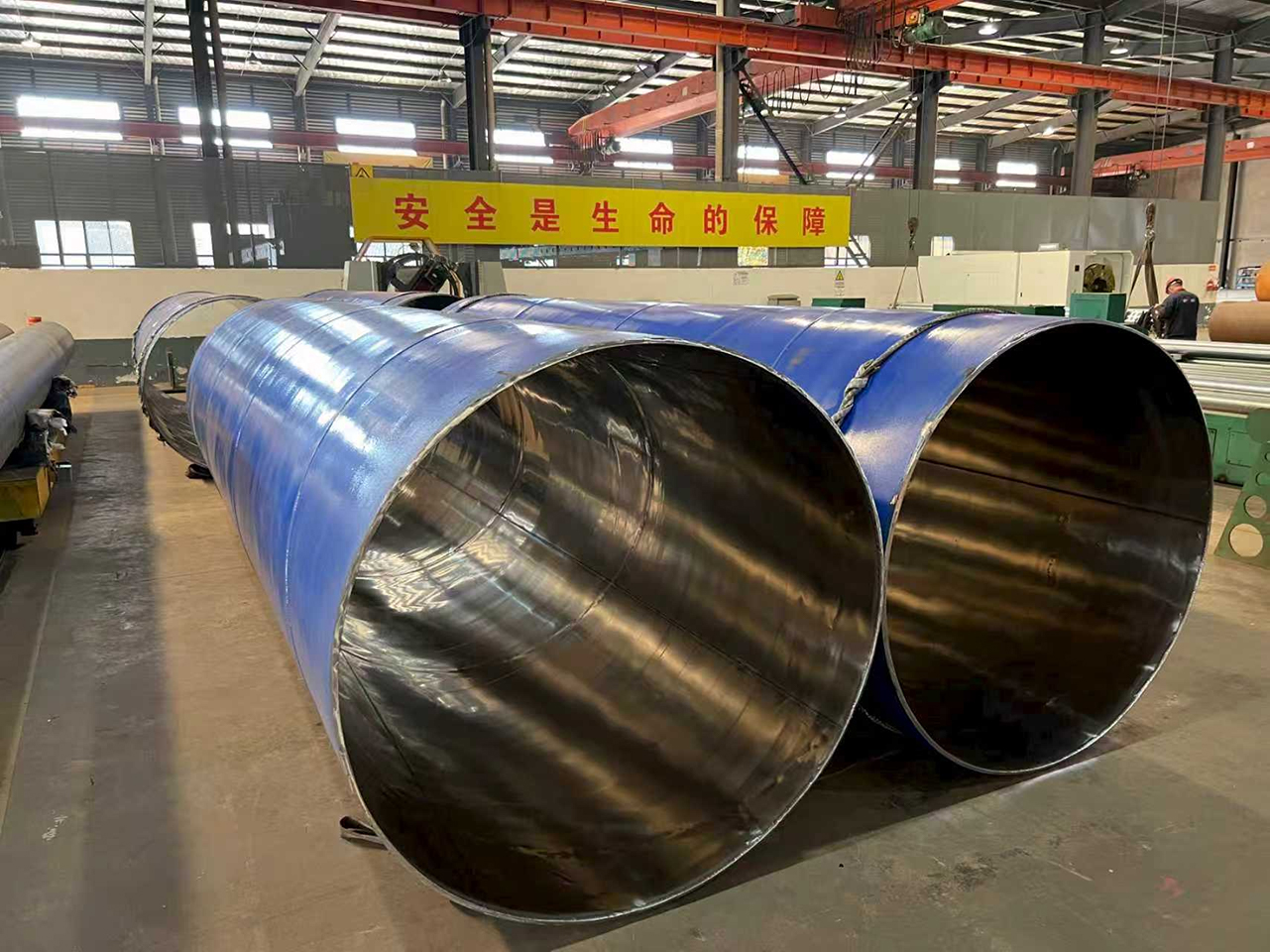
Advantages of API 5LD Clad Steel Pipes
API 5LD clad pipelines offer several advantages compared with conventional carbon steel pipes and solid CRA pipes.
● Cost Efficiency
Clad pipes significantly reduce material costs compared with solid corrosion resistant alloy pipelines.
● High Structural Strength
The carbon steel backing pipe provides excellent mechanical strength and pressure resistance.
● Superior Corrosion Resistance
The CRA liner protects the pipeline from aggressive chemicals and corrosive fluids.
● Long Service Life
API 5LD clad pipes are designed for long-term operation in harsh oil and gas environments.
● Large Diameter Capability
Clad and lined pipes can be manufactured in large diameters that are difficult to achieve with solid CRA pipes.
● These advantages make API 5LD corrosion resistant pipelines an ideal solution for modern oil and gas infrastructure.
Typical Applications of API 5LD Clad and Lined Pipes
API 5LD corrosion resistant pipelines are used in a wide range of oil and gas applications.
Common applications include:
Offshore oil and gas pipelines
Subsea flowlines
Sour gas gathering systems
Produced water pipelines
Seawater injection pipelines
Multiphase hydrocarbon pipelines
Refinery process pipelines
These pipeline systems require both high mechanical strength and excellent corrosion resistance, making API 5LD clad steel pipes an ideal solution.
Womic Steel: Your Partner for API 5LD Clad & Lined Pipes
Womic Steel is not just a pipe manufacturer; it’s an integrated solution provider for corrosion control. Our key strengths include:
● True Plate-to-Pipe Integration: Our proximity and technical collaboration with Womic Steel, a leading producer of metallurgically bonded clad plates, gives us unparalleled control over raw material quality, supply chain, and development. This integration ensures “green channel” priority for material sourcing, translating to faster lead times and consistent quality.
● Advanced R&D Capabilities: We have jointly developed advanced manufacturing processes with the Steel Research Institute, Hunan University of Science and Technology, and other leading partners. This has led to successful trials of large-diameter pipes like φ1016mm X65M + Alloy 625 and φ1067mm L360M + 316L.
● Comprehensive Product Portfolio: We offer both metallurgically bonded clad plate pipes (Φ508–1422mm) and weld overlay clad pipes (Φ430–1422mm), covering the full spectrum of CRA materials required by the oil and gas industry.
● Proven Track Record: Our team has successfully promoted our solutions to international operators like ADNOC and delivered projects for critical industrial applications, demonstrating our commitment to quality and engineering excellence.
Choose Womic Steel for your next project requiring high-performance, cost-effective API 5LD clad pipes. Contact us to discuss your specific material requirements and project challenges.
We pride ourselves on our customization services, fast production cycles, and global delivery network, ensuring your specific needs are met with precision and excellence.
Website: www.womicsteel.com
Email: sales@womicsteel.com
Tel/WhatsApp/WeChat: Victor: +86-15575100681 or Jack: +86-18390957568
Post time: Mar-09-2026