
Introduction: The Piping Challenge in the AI Era
Liquid cooling is rapidly becoming the critical path to solving the thermal management and energy efficiency bottlenecks of high-density AI computing. Per-rack power has climbed from the traditional 10-20 kW range to over 50 kW, with some ultra-high-density scenarios exceeding 100 kW . In cold-plate liquid cooling systems, piping carries the core function of coolant transport and distribution, and its material selection directly affects long-term system reliability, construction timelines, and operational costs.
The complexity of material selection has grown significantly as liquid cooling systems evolve from simple closed loops to multi-tier architectures involving diverse coolants, temperature ranges, and performance requirements. Industry guidance for liquid cooling systems now recognizes several advanced materials as suitable wetted components, supporting broader adoption of high-performance solutions in next-generation data center cooling applications .
This article examines the three primary material categories—metals, elastomers, and engineered polymers—analyzing their respective strengths, limitations, and optimal application scenarios based on current engineering practice and emerging standards.
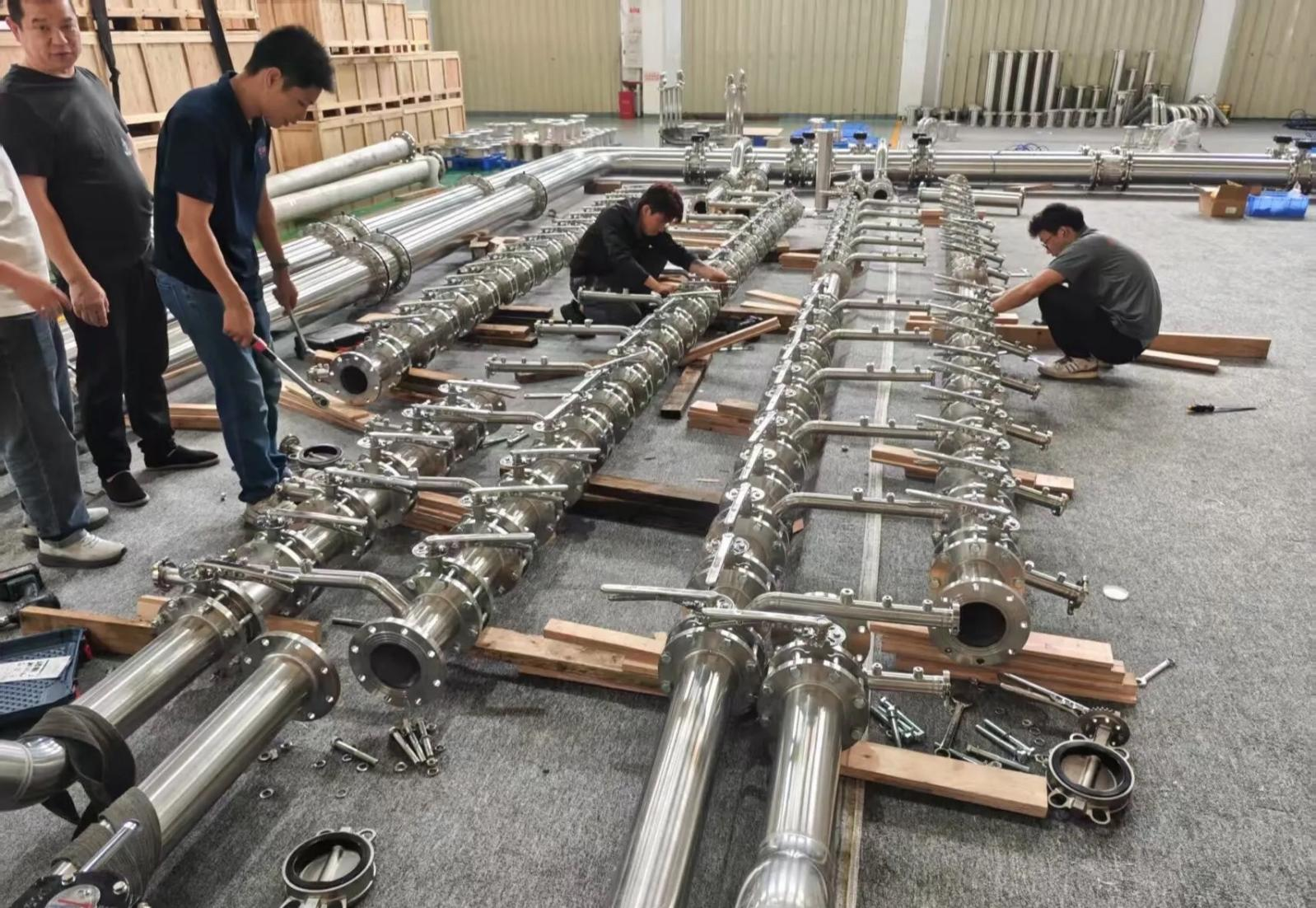
Stainless Steel: The Traditional Workhorse
Why Stainless Remains the Baseline
Stainless steel piping has long been the default choice for data center cooling infrastructure due to its high structural strength, good pressure resistance, and mature technology base. In CDU internal piping, 316L is used as the standard material for most regular applications, featuring good compatibility with deionized water and water-glycol mixtures . The material’s design life of 70-100 years under normal operating conditions makes it attractive for mission-critical infrastructure .
The industry has developed extensive standards and practices around stainless steel piping. ASME B31.3 provides the design framework, with welding procedures qualified to ASME IX or EN ISO 15614 . For hyperscale deployments, roughly 90% of joints are orbital-welded, providing repeatable, full-penetration, gas-purged welds .
304 vs. 316L: The Material Decision
The choice between 304 and 316L is a critical engineering decision with long-term implications. For aqueous coolants (water, glycol solutions), 304 (06Cr19Ni10) is generally recommended as the baseline . However, for chloride-containing environments or fluorinated fluid/mineral oil media, 316L (022Cr17Ni12Mo2) or higher grades are required .
The distinction matters because even minor material incompatibility can lead to performance degradation due to precipitate formation, gas evolution, or surface corrosion . In direct-to-chip cooling loops, where microchannels are highly sensitive to particulate contamination, the consequences of material degradation can be severe.
The Hidden Costs of Metal Systems
Despite its strengths, stainless steel piping has limitations that become more pronounced in high-density deployments:
Electrochemical corrosion risk remains the most prominent concern. Metal piping in prolonged contact with coolant can generate galvanic corrosion between dissimilar metals, continuously releasing metal particulates . Once these microscopic particles enter cold plate microchannels (typically on the micrometer scale), they can cause clogging, compromising heat dissipation efficiency or even damaging chips.
Extended construction and commissioning cycles represent another significant cost. On-site welding is complex and requires extended acid pickling, passivation, and flushing after welding. A standard clean-and-passivate sequence before first fill includes mechanical cleaning, degreasing with alkaline degreaser, pickling with a nitric/hydrofluoric acid mix, and DI water flushing .
Surface contamination risks are often underestimated. A 304 or 316L tube that has been cut, welded, and stored on site develops surface iron contamination and a heat-tint layer at every weld. If the loop is filled with DI water in that state, these become the first places where biofilm will grow .
Elastomers: EPDM and PTFE for Flexible Connections
EPDM: The Workhorse Elastomer
For conventional water and glycol cold-plate liquid cooling systems, EPDM (ethylene propylene diene monomer) is the dominant elastomer choice. Its core advantages include excellent aging and corrosion resistance, an operating temperature range typically from -40°C to +120°C, and relatively controllable costs .
EPDM is widely used for flexible connections, seals, and hoses where movement accommodation is required. Materials compatibility testing has demonstrated EPDM’s stability with commonly used coolants, minimizing degradation risks and ensuring chemical stability over extended operational periods . Peroxide-cured EPDM is specifically recommended for data center fluid networks, providing enhanced durability compared to sulfur-cured variants .
PTFE: The High-Performance Solution
For immersion fluorinated fluid environments, high-temperature applications, and long-life requirements in supercomputing and high-density AI compute, PTFE (polytetrafluoroethylene) is the industry standard choice. Modified PTFE corrugated cooling hoses can operate stably across a wide temperature range from -60°C to +260°C, with slower aging degradation and longer service life .
FEP (fluorinated ethylene propylene), a related fluoropolymer, offers additional benefits: excellent chemical stability, high melting point with operating temperatures from -85°C to 200°C, and outstanding electrical insulation properties . It is commonly used for cold plate liquid cooling RCM-to-server connections .
The key advantage of fluoropolymers lies in their exceptional chemical stability. Except for reactions with fluorine elements at high temperatures, molten alkali metals, and chlorine trifluoride, they remain corrosion-free when in contact with other chemicals . This makes them ideal for aggressive coolants and long service life requirements.
Engineered Polymers: The Emerging Third Path
PVDF: OCP-Inspired Recognition
A significant milestone in polymer adoption occurred when GF received OCP Inspired™ recognition for its PVDF-based in-rack manifold for direct-to-chip liquid cooling—the first polymer-based manifold to receive this recognition within the Open Compute Project program .
The PVDF manifold was developed to support demanding thermal management environments where coolant purity, corrosion resistance, and long-term reliability are critical . Unlike conventional metallic manifolds, the solution uses a polymer design engineered to support uniform flow distribution across all outlet ports, helping maintain stable and repeatable cooling performance throughout the rack . The lightweight PVDF construction also enables corrosion-free operation and simplified integration through flexible connection and mounting options .
Each manifold is custom-engineered according to client-specific rack and cooling requirements and undergoes 100% pressure testing before delivery . The manifold concept has already been validated through multiple proof-of-concept deployments and live data center installations across the Americas, Europe, and Asia-Pacific .
Why Polymer Systems Are Gaining Traction
The engineering case for polymer piping extends beyond the OCP recognition:
Corrosion-free operation: Polymer systems have no electrochemical corrosion risk and do not release metal particulates over long-term operation, helping maintain coolant cleanliness .
Weight reduction: Polymer piping can reduce weight by over 64% compared with equivalent stainless steel systems, facilitating larger-scale prefabricated modular transport and installation .
Smooth internal surfaces: Engineered polymer systems provide smooth internal surfaces that minimize contamination and reduce pressure drop .
Contamination-minimized jointing: Infrared welding technology enables molecular-level joints without filler materials or welding gases, eliminating contamination risk . Unlike orbital welding of stainless steel, which requires a qualified welding procedure specification (WPS) and procedure qualification record (PQR), IR welding provides uniform, defect-free welds with minimal human inconsistency .
Application Boundaries
Polymer piping is not positioned to completely replace metal piping. The boundaries of applicability should be determined by operating conditions:
| Scenario | Recommended Material |
|---|---|
| Aqueous coolants, standard pressure | Stainless steel 304 or polymer alternative |
| Chloride-containing environments | Stainless steel 316L |
| High-purity, corrosion-critical applications | PVDF polymer systems |
| Flexible connections, moderate temperature | EPDM |
| Aggressive fluorinated fluids, high temperature | PTFE/FEP |
| Extreme corrosive conditions | Titanium or SMO254 |
The Layered Material Matching Principle
Current industry practice follows a layered material matching approach, recognizing that different tiers of liquid cooling systems have different operating conditions and performance requirements :
Primary side (dry-cooler to CDU) : Prioritizes pressure resistance and long-distance transport. HDPE/PE100 is increasingly used alongside stainless steel for its lightweight and mature welding technology.
Secondary side (CDU to rack) : Prioritizes cleanliness and temperature stability. PROGEF PP-H and PVDF-based systems are gaining adoption for their corrosion-free operation and smooth internal surfaces.
Rack manifold: Prioritizes flame retardancy and high-precision distribution. PVDF manifolds have demonstrated uniform flow distribution across all outlet ports .
The trend toward polymer adoption is reinforced by the OCP ecosystem’s growing support for interoperable and multi-vendor liquid cooling infrastructures through standardized interfaces and validated material approaches . Industry guidance recognizes several advanced polymers as suitable wetted materials, supporting broader adoption of high-performance polymer technologies in next-generation data center cooling .
Conclusion
Material selection for liquid cooling piping is no longer a simple choice between metals and alternatives. The expanding material palette—from stainless steel (304, 316L) through elastomers (EPDM, PTFE, FEP) to engineered polymers (PVDF, HDPE, PP-H)—provides engineers with options to match specific performance requirements and operating conditions.
The key is understanding that no single material is optimal for all applications. The OCP-Inspired recognition of PVDF manifolds signals an important industry endorsement of polymer solutions, but metal systems remain essential for high-pressure, high-temperature, and chemically aggressive environments. The future likely lies in hybrid approaches that combine the strengths of each material category, applied according to the specific demands of each tier within the liquid cooling architecture.
Post time: Aug-21-2026