


1. Womic Steel: Manufacturing Capabilities & Company Strength API 5L X52 ERW Steel Pipe
Womic Steel Group is a premier manufacturer and global exporter with over 20 years of expertise in producing carbon, alloy, and stainless steel tubular products. Our state-of-the-art ERW pipe production facility spans a comprehensive manufacturing capability exceeding 15,000 tons per month for electric resistance welded steel pipes.
Production Size Range for ERW X52 Pipe: Outside diameter from 60.3mm to 610mm (2 inch to 24 inch) with wall thickness from 4.0mm to 19.1mm (Schedule 10 to Schedule 80). Single random lengths of 6m, double random lengths of 12m, or custom lengths as required.
Quality Certifications & Regulatory Compliance:
ISO 9001:2015 Certified: Quality management system ensuring consistent product quality across all operations.
API 5L Monogram License: Authorized to manufacture API 5L line pipe, demonstrating commitment to highest industry standards for oil and gas transmission pipelines.
CE Marking (PED 2014/68/EU): Compliance with European Pressure Equipment Directive for smooth customs clearance within EEA. DoP provided for EN equivalents.
EN 10204 3.2 Certification: Inspection Certificate 3.2 validated by TÜV, LR, BV, or SGS for critical projects requiring full traceability.
Third-Party Inspection (TPI) Approvals: Products and processes approved by SGS, BV, ABS, LR, DNV, GL, and TÜV for classification society-regulated offshore projects.
Additional Certifications: ISO 14001, ISO 45001, NORSOK M-650, NACE MR0175 / ISO 15156 for sour service applications.
Customer-Specific Approvals: Regular factory audits for major EPC contractors, NOCs, and global energy companies.
Global Recognition: Womic Steel is a trusted supplier to Fortune 500 energy companies and global EPC contractors, serving over 80 countries across Southeast Asia, Europe, the Middle East, Africa, and the Americas.
2. API 5L X52 ERW Steel Pipe: Material Composition & Performance Characteristics
API 5L X52 (also designated as L360 under ISO 3183) is a high-strength line pipe steel grade specifically designed for oil and gas transmission pipelines. The "X" denotes "X42, X52, X65" indicates the minimum yield strength in kilopounds per square inch (KSI). Therefore, X52 has a minimum yield strength of 52,000 psi (approximately 360 MPa). The "L360" designation under ISO standard represents the same material with yield strength of 360 MPa.
Compared to lower grades like GR.B (35,000 psi yield) and X42 (42,000 psi yield), X52 offers superior strength while maintaining excellent weldability and toughness. This balance makes X52 the most widely specified grade for medium-pressure onshore and offshore pipeline projects worldwide. X52 provides optimal performance for pipelines operating at pressures up to 1,500 psi, depending on wall thickness and diameter configuration.
API 5L X52 ERW Steel Pipe Chemical Composition (Ladle Analysis, % by mass):
| Element | C | Si | Mn | P | S | Cr | Mo | Ni | Cu | Nb | V | Ti | Al |
| PSL1 Max % | 0.28 | — | 1.40 | 0.030 | 0.030 | — | — | — | — | 0.05 | 0.10 | 0.04 | — |
| PSL2 Max % | 0.24 | 0.45 | 1.40 | 0.025 | 0.015 | 0.30 | 0.15 | 0.30 | 0.50 | 0.10 | 0.10 | 0.04 | 0.060 |
*Note: PSL2 requirements are significantly more stringent with lower carbon, phosphorus, and sulfur limits. The addition of micro-alloying elements (Niobium, Vanadium, Titanium) refines grain structure and enhances both strength and low-temperature toughness. PSL2 also requires controlled carbon equivalent (CE) values: CE(IIW) ≤ 0.43% for seamless and ≤ 0.43% for welded pipes with wall thickness ≤ 19mm.*
API 5L X52 ERW Steel Pipe Mechanical Properties (Room Temperature):
| Property | PSL1 Requirement | PSL2 Requirement |
| Yield Strength (ReH / Rt0.5) | 52,000 - 77,000 psi (360 - 530 MPa) | 52,000 - 77,000 psi (360 - 530 MPa) |
| Tensile Strength (Rm) | ≥ 66,000 psi (≥ 460 MPa) | ≥ 66,000 psi (≥ 460 MPa) |
| Ratio (Yield/Tensile) | No specific limit | ≤ 0.93 |
| Elongation (A min) | Calculated per formula | Calculated per formula |
| Hardness (HRC / HV) | No requirement | ≤ 27 HRC / ≤ 250 HV10 |
*Note: PSL2 imposes additional requirements including maximum yield-to-tensile ratio of 0.93, maximum hardness limits for sour service applications, and enhanced Charpy V-Notch impact toughness values. For PSL2, minimum impact energy is 40J (average) and 30J (individual) at 0°C for pipe body, weld, and HAZ.*
API 5L X52 ERW Steel Pipe Low-Temperature Impact Properties (Charpy V-Notch) - PSL2:
| Test Location | Temperature | Average Energy (Min) | Individual Energy (Min) |
| Pipe Body (Longitudinal) | 0°C | 40 Joules | 30 Joules |
| Weld Metal (Transverse) | 0°C | 40 Joules | 30 Joules |
| Heat Affected Zone (HAZ) | 0°C | 40 Joules | 30 Joules |
| Sour Service Option | -10°C or lower | As specified | As specified |
*Note: For sour service applications (HIC/SSC resistance), impact testing at lower temperatures (-10°C, -20°C, or -46°C) and additional hardness restrictions (≤ 22 HRC / ≤ 248 HV10) are required per Annex H of API 5L.*
API 5L X52 ERW Steel Pipe Carbon Equivalent Limits (PSL2):
| Wall Thickness | CE (IIW) Maximum | CET Maximum |
| t ≤ 19mm (0.748") | 0.43% | 0.25% |
| 19mm < t ≤ 40mm (1.575") | 0.43% | 0.25% |
| t > 40mm | By agreement | By agreement |
Note: Low carbon equivalent ensures excellent weldability in field conditions without preheating for most wall thicknesses, reducing installation costs and time.
3. API 5L X52 ERW Steel Pipe Dimensional Range & Standards Compliance
Womic Steel supplies API 5L X52 ERW pipes across a wide dimensional spectrum, fully compliant with API 5L 46th Edition and ISO 3183 standards.
| Item | Specification |
| Standard | API 5L 46th Edition / ISO 3183 |
| Product Specification Level | PSL1 (Standard) / PSL2 (Enhanced) |
| Grade | X52 (L360) |
| Manufacturing Process | Electric Resistance Welding (ERW) / High Frequency Welding (HFW) |
| Outside Diameter Range | 60.3mm – 610mm (2 inch – 24 inch) |
| Wall Thickness Range | 4.0mm – 19.1mm (Schedule 10 – Schedule 80) |
| Length | 6m (SR), 12m (DR), or custom lengths up to 18m |
| End Finish | Plain End (PE) / Beveled End (BE) / Threaded & Coupled (T&C) |
| Surface Finish | Bare / Oiled / Black Coated / 3PE / FBE / Galvanized |
4. Available Dimensions & Specifications - ERW Steel Pipe
|
NB |
Size |
OD mm |
SCH40S mm |
SCH5S mm |
SCH10S mm |
SCH10 mm |
SCH20 mm |
SCH40 mm |
SCH60 mm |
XS/80S mm |
SCH80 mm |
SCH100 mm |
SCH120 mm |
SCH140 mm |
SCH160 mm |
SCHXXS mm |
|
6 |
1/8” |
10.29 |
1.24 |
1.73 |
2.41 |
|||||||||||
|
8 |
1/4” |
13.72 |
1.65 |
2.24 |
3.02 |
|||||||||||
|
10 |
3/8” |
17.15 |
1.65 |
2.31 |
3.20 |
|||||||||||
|
15 |
1/2” |
21.34 |
2.77 |
1.65 |
2.11 |
2.77 |
3.73 |
3.73 |
4.78 |
7.47 |
||||||
|
20 |
3/4” |
26.67 |
2.87 |
1.65 |
2.11 |
2.87 |
3.91 |
3.91 |
5.56 |
7.82 |
||||||
|
25 |
1” |
33.40 |
3.38 |
1.65 |
2.77 |
3.38 |
4.55 |
4.55 |
6.35 |
9.09 |
||||||
|
32 |
1 1/4” |
42.16 |
3.56 |
1.65 |
2.77 |
3.56 |
4.85 |
4.85 |
6.35 |
9.70 |
||||||
|
40 |
1 1/2” |
48.26 |
3.68 |
1.65 |
2.77 |
3.68 |
5.08 |
5.08 |
7.14 |
10.15 |
||||||
|
50 |
2” |
60.33 |
3.91 |
1.65 |
2.77 |
3.91 |
5.54 |
5.54 |
9.74 |
11.07 |
||||||
|
65 |
2 1/2” |
73.03 |
5.16 |
2.11 |
3.05 |
5.16 |
7.01 |
7.01 |
9.53 |
14.02 |
||||||
|
80 |
3” |
88.90 |
5.49 |
2.11 |
3.05 |
5.49 |
7.62 |
7.62 |
11.13 |
15.24 |
||||||
|
90 |
3 1/2” |
101.60 |
5.74 |
2.11 |
3.05 |
5.74 |
8.08 |
8.08 |
||||||||
|
100 |
4” |
114.30 |
6.02 |
2.11 |
3.05 |
6.02 |
8.56 |
8.56 |
11.12 |
13.49 |
17.12 |
|||||
|
125 |
5” |
141.30 |
6.55 |
2.77 |
3.40 |
6.55 |
9.53 |
9.53 |
12.70 |
15.88 |
19.05 |
|||||
|
150 |
6” |
168.27 |
7.11 |
2.77 |
3.40 |
7.11 |
10.97 |
10.97 |
14.27 |
18.26 |
21.95 |
|||||
|
200 |
8” |
219.08 |
8.18 |
2.77 |
3.76 |
6.35 |
8.18 |
10.31 |
12.70 |
12.70 |
15.09 |
19.26 |
20.62 |
23.01 |
22.23 |
|
|
250 |
10” |
273.05 |
9.27 |
3.40 |
4.19 |
6.35 |
9.27 |
12.70 |
12.70 |
15.09 |
19.26 |
21.44 |
25.40 |
28.58 |
25.40 |
|
|
300 |
12” |
323.85 |
9.53 |
3.96 |
4.57 |
6.35 |
10.31 |
14.27 |
12.70 |
17.48 |
21.44 |
25.40 |
28.58 |
33.32 |
25.40 |
|
|
350 |
14” |
355.60 |
9.53 |
3.96 |
4.78 |
6.35 |
7.92 |
11.13 |
15.09 |
12.70 |
19.05 |
23.83 |
27.79 |
31.75 |
35.71 |
|
|
400 |
16” |
406.40 |
9.53 |
4.19 |
4.78 |
6.35 |
7.92 |
12.70 |
16.66 |
12.70 |
21.44 |
26.19 |
30.96 |
36.53 |
40.49 |
|
|
450 |
18” |
457.20 |
9.53 |
4.19 |
4.78 |
6.35 |
7.92 |
14.27 |
19.05 |
12.70 |
23.83 |
29.36 |
34.93 |
39.67 |
45.24 |
|
|
500 |
20” |
508.00 |
9.53 |
4.78 |
5.54 |
6.35 |
9.53 |
15.09 |
20.62 |
12.70 |
26.19 |
32.54 |
38.10 |
44.45 |
50.01 |
|
|
550 |
22” |
558.80 |
9.53 |
4.78 |
5.54 |
6.35 |
9.53 |
22.23 |
12.70 |
28.58 |
34.93 |
41.28 |
47.63 |
53.98 |
||
|
600 |
24” |
609.60 |
9.53 |
5.54 |
6.35 |
6.35 |
9.53 |
17.48 |
24.61 |
12.70 |
30.96 |
38.89 |
46.02 |
52.37 |
59.54 |
|
|
650 |
26” |
660.40 |
9.53 |
7.92 |
12.70 |
12.70 |
Note: Wall thickness availability may vary based on pipe diameter and manufacturing capability. Custom dimensions outside this range available upon request.
5. Common ERW Steel Pipe Standards Manufactured by Womic Steel
|
Standard |
Regular Grades |
Typical Application |
| API 5L (Specification for Line Pipe) | ||
| API 5L PSL1 / PSL2 | GR.B, X42, X52, X60, X65, X70 | Oil and gas transmission, onshore/offshore pipelines |
| ASTM Line Pipe & Structural Pipe | ||
| ASTM A53 (Specification for Pipe, Steel, Black and Hot-Dipped, Zinc-Coated, Welded and Seamless) | GR.A, GR.B | Water, gas, steam, air, structural applications |
| ASTM A135 (Specification for Electric-Resistance-Welded Steel Pipe) | GR.A, GR.B | Water, gas, steam, refinery services |
| ASTM A252 (Specification for Welded and Seamless Steel Pipe Piles) | GR.1, GR.2, GR.3 | Foundation piling, marine piling, bridge foundation |
| ASTM A500 (Specification for Cold-Formed Welded and Seamless Carbon Steel Structural Tubing) | GR.A, GR.B, GR.C | Structural tubing, building frames, bridges |
| ASTM A501 (Specification for Hot-Formed Welded and Seamless Carbon Steel Structural Tubing) | GR.A, GR.B | Heavy structural applications, columns, trusses |
| ASTM Boiler & Heat Exchanger (ERW) | ||
| ASTM A178 (Specification for Electric-Resistance-Welded Carbon Steel and Carbon-Manganese Steel Boiler Tubes) | Grade A, C, D | Boiler tubes, superheater tubes |
| ASTM A214 (Specification for Electric-Resistance-Welded Carbon Steel Heat Exchanger and Condenser Tubes) | — | Heat exchangers, condensers |
| ASTM A250 (Specification for Electric-Resistance-Welded Ferritic Alloy Steel Boiler and Superheater Tubes) | T1, T2, T5, T9, T11, T22 | High temperature boiler and superheater |
| ASTM A334 (Specification for Seamless and Welded Carbon and Alloy Steel Tubes for Low-Temperature Service) | GR.1, GR.3, GR.6 | Low temperature service, cryogenic |
| EN / DIN / BS Standards | ||
| EN 10217-1 (Welded steel tubes for pressure purposes - Non-alloy steel tubes with specified room temperature properties) | P235TR1, P265TR1 | Pressure vessels, boiler drums, high pressure piping |
| EN 10217-2 (Welded steel tubes for pressure purposes - Non-alloy and alloy steel tubes with specified elevated temperature properties) | P235GH, P265GH, P295GH, P355GH | Elevated temperature, boiler tubes, heat exchangers |
| EN 10219-1 (Cold-formed welded steel hollow sections for structural purposes) | S235JRH, S275J0H, S275J2H, S355J0H, S355J2H, S355K2H | Structural applications, building construction, bridges |
| EN 10210(Hot finished structural hollow sections of non-alloy and fine grain steels) | S235JRH, S275J0H, S275J2H, S355J0H, S355J2H, S355K2H S420MH, S460MH | Hot formed seamless/welded hollow sections for structural purposes, building construction, bridges |
| EN 10025-2 (Hot-rolled products of structural steels - Non-alloy structural steels) | S235JR, S275JR, S355JR, | General structural steelwork, civil engineering |
| EN 10255 (Non-alloy steel tubes suitable for welding and threading) | S195T, S235JRTH | Water, gas, sewage, threaded pipe systems |
| EN 10305-2 (Steel tubes for precision applications - Welded cold drawn tubes) | E215, E235, E355 | Precision applications, hydraulic cylinders |
| BS 1387 (Specification for screwed and socketed steel tubes and tubulars) | Class A, B, C | Water, gas, steam, scaffolding, threaded pipe |
| DIN 2458 (Welded steel tubes and fittings - General technical delivery conditions) | St37.0, St44.0, St52.0 | General welded steel tubes, structural applications |
| ISO & Other Standards | ||
| ISO 3183 (Petroleum and natural gas industries - Steel pipe for pipeline transportation systems) | L245, L290, L360, L415 | Oil and gas pipelines (ISO equivalent of API 5L) |
| ISO 65 (Steel tubes for water, gas, and sewage - Threaded tubes) | Medium, Heavy | Water, gas, sewage, threaded pipe |
| CSA G40.21 (Structural quality steel - Canadian standard) | 44W, 50W | Structural applications (Canada) |
| AS 1163 (Structural steel hollow sections - Australian standard) | C250, C350, C450 | Structural hollow sections (Australia) |
| GOST 10706 (Welded steel pipes for pipelines and structures - Russian standard) | St20, St35, St45 | Pipelines, structural applications (Russia) |
Usage: Oil and gas transmission, water and sewage, structural projects, scaffolding, piling foundation, high pressure fluid, chemical processing, power generation, construction, marine engineering, boiler tubes, heat exchangers, superheaters, condensers, low temperature service, precision applications, hydraulic cylinders, threaded pipe systems
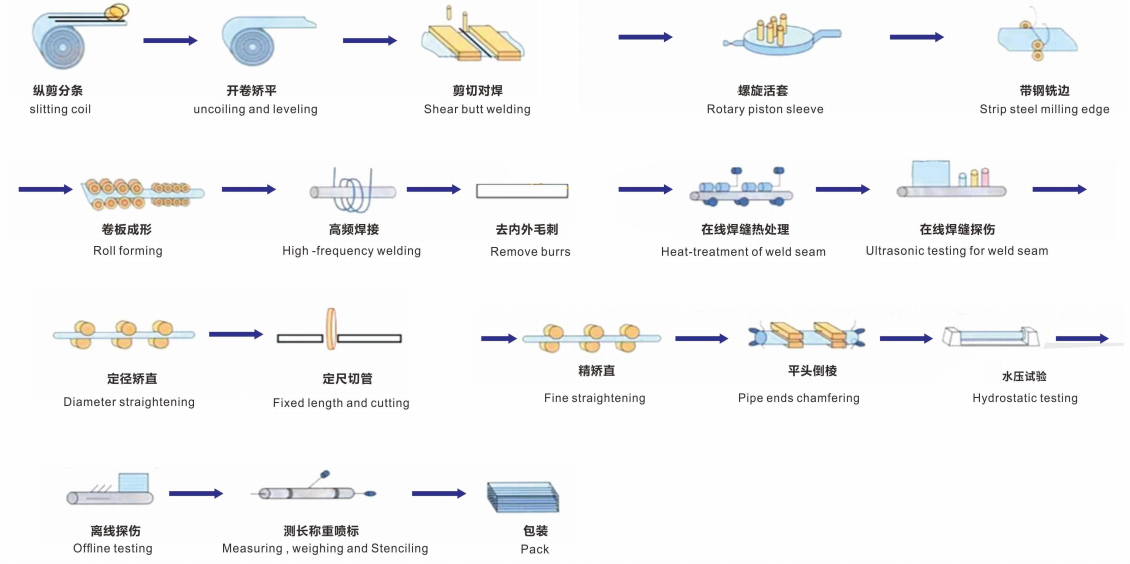
6. Manufacturing Process - ERW / HFW Steel Pipe
Raw Material Inspection: Incoming steel coils are verified for chemical composition, mechanical properties, and surface quality. Each coil is assigned a unique heat number for full traceability.
Uncoiling & Leveling: Coils are uncoiled and leveled to flatten the strip and remove coil set, ensuring uniform flatness for consistent forming.
Edge Milling & Trimming: Both edges of the strip are milled to precise width tolerance (±0.5mm), creating a clean, parallel surface for high-quality weld formation.
Cold Forming: The leveled strip passes through forming rolls which gradually shape the flat strip into an open cylindrical tube shell.
High-Frequency Welding (HFW/ERW): High-frequency current (200-500 kHz) heats the mating edges to forging temperature (1,350-1,500°C). Squeeze rolls press the heated edges together, creating a forged weld without filler material.
Weld Bead Removal: Internal and external flash is removed by carbide scarfing blades while hot, producing a smooth surface with minimal weld reinforcement.
Sizing: The welded tube passes through sizing rolls to achieve precise OD tolerance (±0.5% to ±1.0%). Additional rolls produce square/rectangular shapes if required.
Heat Treatment (Optional): Normalizing at 890-930°C may be applied for enhanced ductility or stress relief, producing uniform ferrite-pearlite microstructure.
Cutting to Length: Pipe is cut to specified lengths using flying cut-off saws with precision control (±3mm).
Non-Destructive Testing:
● Ultrasonic Testing (UT): 100% inspection of weld seam and pipe body for laminations, inclusions, and lack of fusion.
● Eddy Current Testing (ET): Continuous on-line weld quality inspection.
● Hydrostatic Testing: Each pipe tested to 95% of SMYS for minimum 10 seconds.
End Finishing: Plain ends, beveled ends (30°-35° with 1.6mm landing), or threaded ends as per customer specification.
Final Inspection & Marking: Visual inspection, dimensional verification (OD, WT, length, straightness), and permanent marking per standard (grade, size, heat number, manufacturer).
7. Quality Control & Testing Procedures
| Stage | Inspection Method | Purpose |
| Raw Material | Chemical Analysis (OES Spectrometer) | Verify compliance with API 5L composition limits |
| Raw Material | Tensile Testing | Verify yield, tensile strength, elongation |
| In-Process | Dimensional Inspection (Micrometers, Calipers) | Monitor OD, WT during forming and sizing |
| Weld Zone | Ultrasonic Testing (UT) - On-Line | Detect weld discontinuities, lack of fusion |
| Weld Zone | Eddy Current Testing (ET) - On-Line | Continuous weld seam quality monitoring |
| Weld Zone | Weld Seam Macro-Examination | Verify weld penetration and fusion geometry |
| Finished Pipe | Hydrostatic Testing (10 sec min at 95% SMYS) | Verify pressure integrity and leak-tightness |
| Finished Pipe | Ultrasonic Testing (UT) - Off-Line (Optional) | Full body laminar inspection |
| Finished Pipe | Magnetic Particle Inspection (MPI) | Surface crack detection (weld and HAZ) |
| Finished Pipe | Charpy V-Notch Impact Test | Verify low-temperature toughness (PSL2) |
| Finished Pipe | Hardness Test (HRC / HV10) | Verify maximum hardness limits (sour service) |
| Finished Pipe | Guided Bend Test (Face & Root) | Verify weld ductility and soundness |
| Finished Pipe | Flattening Test | Verify ductility and soundness of pipe body |
| Finished Pipe | Dimensional & Visual Inspection | Verify OD, WT, length, straightness, surface quality |
| Finished Pipe | Marking Verification | Ensure permanent marking per API 5L |
Additional Tests for PSL2 / Sour Service:
● HIC (Hydrogen Induced Cracking) Test per NACE TM0284
● SSC (Sulfide Stress Cracking) Test per NACE TM0177 Method A
● CVN Impact Testing at -10°C, -20°C, or -46°C
● Hardness Verification (≤ 22 HRC / ≤ 248 HV10 for HIC resistant)
Quality Documentation:
● Mill Test Certificate per EN 10204 Type 2.2, 3.1, or 3.2
● Hydrostatic Test Report (pipe-by-pipe)
● UT / ET Inspection Report
Traceability from heat number to finished pipe
8. Primary Applications ERW Steel Pipe
ERW pipes are essential components in oil & gas transmission and various industrial applications:
Oil & Gas Transmission: Long-distance onshore and offshore pipelines for crude oil, natural gas, and refined petroleum products.
High-Pressure Fluid Transportation: Water injection lines, produced water disposal systems, and high-pressure fluid transfer in oilfields and processing facilities.
Onshore Pipeline Projects: Cross-country gathering lines, trunk lines, and distribution pipelines in oil and gas fields.
Offshore Pipeline Systems: Subsea flowlines, risers, and export pipelines for offshore platforms and subsea completions (with PSL2 and sour service options).
Sour Service Environments: Pipelines handling wet sour gas (H₂S containing) requiring PSL2 with supplementary requirements including HIC and SSC resistance per NACE standards.
Water Transmission: Large-diameter water supply pipelines, irrigation systems, and raw water transmission for municipal and industrial use.
Sewage & Wastewater Treatment: Effluent outfall lines, treatment plant piping, and sludge handling systems.
Industrial Structural Applications: Pipe racks, supports, bracing, and structural components in refineries, petrochemical plants, and industrial facilities.
Oil & Gas Processing Facilities: Flow lines, headers, manifolds, and interconnecting piping in processing plants and compressor stations.
EPC & Plant Piping: Process and utility piping in refineries, gas processing plants, chemical complexes, and power generation facilities.
9. Packaging & Shipping
ERW pipes are packaged and shipped with utmost care to ensure their protection during transit. Here is a description of the packaging and shipping process:
Packaging:
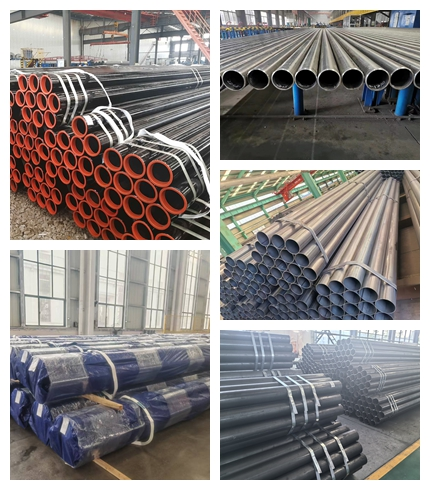
Protective Coating: Before packaging, pipes may be coated with a thin layer of anti-rust oil or protective varnish to prevent surface corrosion and oxidation during storage and transit. Bare finish also available for immediate coating application at destination.
Bundling: Pipes of similar dimensions and specifications are carefully bundled together in hexagonal or rectangular bundles. They are secured using steel straps (typically 3-5 straps per bundle) to prevent movement within the bundle.
End Caps: Plastic end caps (PE or PP) are placed on both ends of each pipe to protect beveled ends, plain ends, and threaded connections from impact damage, debris ingress, and moisture.
Padding and Cushioning: For premium export orders, padding materials such as foam rings or rubber strips may be used between pipe layers to prevent abrasion and coating damage during handling.
Wooden Crates or Cases: For thin-walled pipes, precision tubes, or premium coating orders, pipes may be packed in sturdy wooden crates or plywood cases to provide enhanced protection against external forces and rough handling.
Shipping:
Mode of Transportation: Pipes shipped via container vessels (20ft/40ft), bulk carriers, or rail freight depending on destination, volume, and urgency. Air freight available for sample or time-critical shipments.
Containerization: Small to medium orders loaded into standard shipping containers, protecting cargo from weather, moisture, and external contaminants during transit.
Bulk Vessel Loading: Large-volume orders (typically >200 tons) loaded directly into bulk carriers. Lifting beams and spreader bars prevent damage; dunnage and lashing secure cargo against sea motion.
Labeling & Documentation: Each bundle clearly labeled with grade, standard, dimensions, heat number, and handling instructions. Complete documentation (commercial invoice, packing list, bill of lading, Certificate of Origin, Mill Test Certificates) prepared for smooth customs clearance.
Secure Fastening: Bundles secured with steel strapping, dunnage bags, or timber bracing to prevent shifting, rolling, or damage during transit.
Tracking & Insurance: Container tracking numbers provided for real-time monitoring. Marine cargo insurance (All Risk or With Average) available upon request.
In summary, Womic Steel ensures that all ERW Steel pipes are packaged with industry-leading protective measures and shipped using reliable transportation methods to reach their destination in optimal condition. Proper packaging and shipping procedures are essential to preserving the integrity and quality of the delivered products.
10. Womic Steel Advantages & FAQ
Why Partner with Womic Steel?
One-Stop Shop: Complete range from API 5L ERW pipes to matching OEM pipe fittings (Elbows, Tees, Reducers, Flanges, Caps) in compatible material grades, including carbon steel, alloy steel, and stainless steel.
Technical Compliance: Full Mill Test Certificates (EN 10204 Type 2.2, 3.1, or 3.2) provided with every shipment, detailing exact chemical composition, mechanical test results, and non-destructive examination reports.
Value-Added Services: End beveling (30°-35°), threading & coupling, plastic caps installation, and anti-corrosion coating (FBE, 3LPE, 3LPP, Epoxy, Galvanizing) available in-house or through qualified partner facilities.
Competitive Logistics: Strategic partnership with global freight forwarders ensures optimized container loading (maximizing quantity per container) and cost-effective worldwide shipping with reliable transit times.
Inventory & Availability: Extensive stock of standard API 5L X52 sizes (2"-24" OD, Schedule 10-80) ensures short lead times and rapid response to urgent project requirements. Custom sizes produced on demand with typical lead time of 30-45 days.
Sour Service Capability: Full capability to supply PSL2 pipes with HIC and SSC testing per NACE standards for sour gas applications. Hardness controlled to ≤ 248 HV10 / ≤ 22 HRC.
Choose Womic Steel Group as your reliable partner for high-quality API 5L X52 ERW Steel Pipes and unbeatable delivery performance. Welcome to inquire!
Website: www.womicsteel.com
Email: sales@womicsteel.com
Tel/WhatsApp/WeChat:
Victor: +86-15575100681
Jack: +86-18390957568
Frequently Asked Questions (FAQ)
Q: What is the difference between API 5L PSL1 and PSL2 for X52 pipes?
A: PSL1 (Product Specification Level 1) is the standard quality level with basic chemical and mechanical requirements. PSL2 (Product Specification Level 2) imposes stricter limits on carbon, phosphorus, sulfur, requires maximum yield-to-tensile ratio of 0.93, mandatory Charpy impact testing, and enhanced non-destructive examination. PSL2 is required for sour service, offshore, and critical pipeline applications. For X52, PSL2 also requires lower carbon equivalent (CE ≤ 0.43%) for better weldability.
Q: Can API 5L X52 pipe be used for structural applications?
A: Yes. X52's minimum yield strength of 360 MPa (52,000 psi) makes it suitable for many structural applications including pipe racks, support columns, bracing, and heavy structural framing. However, for purely structural applications (non-pressure), ASTM A500 GR.B or A53 GR.B may be more cost-effective options.
Q: What is the difference between ERW and HFW? Which is better for X52 pipe?
A: ERW (Electric Resistance Welding) and HFW (High Frequency Welding) are often used interchangeably. HFW specifically uses high-frequency current (typically 200-500 kHz) which produces a narrower heat-affected zone (HAZ) and superior weld quality compared to conventional low-frequency ERW. For API 5L X52, HFW is the preferred process as it provides better weld toughness and narrower HAZ, essential for sour service and low-temperature applications.
Q: What does "sour service" mean and can you supply X52 for sour service?
A: Sour service refers to pipelines carrying wet gas containing hydrogen sulfide (H₂S). Under these conditions, standard steel may suffer from Hydrogen Induced Cracking (HIC) or Sulfide Stress Cracking (SSC). Yes, Womic Steel supplies X52 PSL2 with sour service supplementary requirements per API 5L Annex H, including HIC testing (NACE TM0284), SSC testing (NACE TM0177), and hardness control (≤ 248 HV10 / ≤ 22 HRC).
Q: What is the maximum length available for API 5L X52 ERW pipe?
A: We supply ERW pipes in standard fixed lengths up to 12 meters (approximately 40 feet) for diameters up to 610mm (24"). For smaller diameters (below 168mm / 6"), lengths up to 18 meters (60 feet) are available upon request. Longer lengths for specific projects require detailed specification and engineering review.
Q: What types of end finishes do you offer for X52 line pipe?
A: We provide Plain Ends (square cut for butt welding or mechanical couplings), Beveled Ends (30°-35° bevel angle with 1.6mm ±0.8mm landing for field butt welding), Threaded Ends (API or customer-specified threads), and Coupled Ends (with coupling threaded onto pipe ends). Custom end preparation is available to meet specific installation requirements.
Q: Can you provide third-party inspection for API 5L X52 pipes?
A: Yes. We welcome and facilitate inspections by DNV, BV, SGS, TÜV, ABS, LR, or any client-nominated representative during production (witnessing hydrotest, UT, dimensional inspection) and prior to shipment. 3.2 inspection certificates validated by authorized third-party bodies are routinely supplied upon request.
Q: Do you provide cut-to-length services for X52 pipe?
A: Yes. We offer precision cutting to exact customer-specified lengths with tight tolerances (typically ±3mm) and clean, burr-free ends. Cutting can be followed by end beveling (for welding) or threading (for mechanical connections) as required.
Q: What coating options are available for API 5L X52 ERW pipe?
A: We offer various coating options including: FBE (Fusion Bonded Epoxy) - single or dual layer; 3LPE / 3LPP (Three Layer Polyethylene / Polypropylene); Coal Tar Epoxy; Liquid Epoxy; Galvanizing (Hot Dip or Electro); and Black coating (lacquer or varnish). Coating can be applied at our facility or through qualified partner coating plants with applicable certifications.
Q: What is the lead time for API 5L X52 PSL2 with sour service requirements?
A: Standard lead time for PSL2 with sour service requirements (including HIC and SSC testing) is approximately 45-60 days from order confirmation, depending on order quantity and specific test requirements. Rush orders (30-45 days) may be available for smaller quantities. Please contact us for current lead times based on your specific requirements.
Related Products
-

ASTM A312 TP316H Welded Stainless Steel Pipe: M...
-

ASTM A790 S32760 Super Duplex Stainless Steel W...
-

ASTM A312 TP310S / TP310H Welded Stainless Stee...
-

ASTM A790 S32750 Super Duplex Stainless Steel W...
-

ASTM A312 TP309 / TP309H Welded Stainless Steel...
-

ASTM A790 S31803 Duplex Stainless Steel Welded ...
-

ASTM A312 TP304N Welded Stainless Steel Pipe: M...
-

ASTM A790 / A789 S32205 Duplex Stainless Steel ...
-

ASTM A312 TP304/304L Welded Stainless Steel Pipe