


1. Womic Steel: Manufacturing Capabilities & Company Strength
Womic Steel Group is a premier manufacturer and global exporter with over 20 years of expertise in producing carbon, alloy, and stainless steel tubular products. Our state-of-the-art piling pipe production facility spans a comprehensive manufacturing capability exceeding 20,000 tons per month for marine steel piling pipes, utilizing both ERW and LSAW/SSAW processes.
Production Size Range for Marine Piling Pipe: Outside diameter from 219mm to 660mm (8 inch to 26 inch) for ERW process, and from 508mm to 3,000mm (20 inch to 120 inch) for LSAW/SSAW process. Wall thickness from 6.0mm to 25.4mm for ERW, and from 6.0mm to 50.8mm for LSAW/SSAW. Single lengths from 6m to 18m standard, with custom lengths up to 60m available for deep foundation projects.
Quality Certifications & Regulatory Compliance:
ISO 9001:2015 Certified: Quality Management System for piling pipe production and quality control processes, ensuring consistent product quality and continuous improvement across all manufacturing operations.
API 5L / API 2B Monogram License: Womic Steel holds API 5L license for Line Pipe manufacturing and API 2B license for Structural Steel Pipe for marine applications. The API Monogram represents our commitment to the highest industry standards for oil & gas transmission and offshore structural piling pipes. Regular API audits ensure ongoing compliance with specification requirements.
CE Marking (PED 2014/68/EU): Our piling pipes and structural tubes comply with the European Pressure Equipment Directive (PED) 2014/68/EU. CE marking is available upon request to facilitate smooth customs clearance and project acceptance within the European Economic Area (EEA). Declaration of Performance (DoP) provided for EN standard products.
EN 10204 3.2 Certification: In addition to standard 2.2 and 3.1 Mill Test Certificates, we supply products with Inspection Certificate 3.2, validated by EU-authorized third-party bodies (TÜV, LR, BV, SGS) for critical marine and foundation projects requiring full material traceability and independent verification.
Third-Party Inspection (TPI) Approvals: Our products and production processes are approved and audited by major international agencies and Classification Societies including SGS, BV, ABS, LR, DNV, GL, and TÜV. These approvals demonstrate our capability to supply piling pipes for classification society-regulated marine and offshore projects.
Additional Certifications Available:
ISO 14001:2015 (Environmental Management System) – Committed to sustainable manufacturing practices
ISO 45001:2018 (Occupational Health & Safety Management System) – Ensuring safe working environment
FPC (Factory Production Control) per EN 10248 / EN 10219 – Self-declaration of conformity for CE marking
NORSOK M-650 (Norwegian standard for steel materials) – Available for offshore North Sea projects
KTA 3211.2 (German nuclear standard) – Available for nuclear facility piling applications
Customer-Specific Approvals: We regularly undergo factory audits and approvals for major EPC contractors, port authorities, and energy companies globally. Documentation and audit support provided for supplier qualification processes.
Global Recognition: Womic Steel is a trusted supplier to global EPC contractors, port authorities, marine engineering firms, and foundation contractors, serving over 80 countries across Southeast Asia, Europe, the Middle East, Africa, and the Americas.
2. ASTM A252 GR.3 & EN 10248 S355GP: Material Composition & Performance Characteristics
ASTM A252 GR.3 is the American standard specification for welded and seamless steel pipe piles. The "GR.3" designation indicates Grade 3, which has the highest strength requirement among the three ASTM A252 grades (GR.1, GR.2, GR.3). Grade 3 offers a minimum yield strength of 345 MPa (50,000 psi), making it the preferred choice for deep foundation, marine piling, and heavy load-bearing applications where high structural integrity is required.
EN 10248 S355GP is the European standard for hot-rolled steel sheet piling and pipe piling. The "S" denotes structural steel, "355" indicates minimum yield strength of 355 MPa, and "GP" stands for "General Piling" (general piling application). S355GP offers slightly higher yield strength than ASTM A252 GR.3 (355 MPa vs 345 MPa) and is widely specified for European, Middle Eastern, and African marine construction projects.
Both grades are specifically formulated for piling applications, offering excellent weldability for field splicing, good low-temperature toughness for marine environments, and sufficient ductility to withstand driving stresses during pile installation. Compared to standard structural grades like A36 or S235JR, these piling grades provide significantly higher load-bearing capacity, allowing for deeper driving depths and reduced pile quantities.
Chemical Composition (Ladle Analysis, % by mass):
| Element | ASTM A252 GR.3 (Max %) | EN 10248 S355GP (Max %) |
| C | 0.26 | 0.22 |
| Si | — | 0.55 |
| Mn | 1.35 | 1.60 |
| P | 0.040 | 0.035 |
| S | 0.050 | 0.035 |
| Cu | — | 0.55 |
| CE (max) | — | 0.45 |
Note: EN 10248 S355GP has more stringent limits on carbon, phosphorus, and sulfur, resulting in better weldability and toughness compared to ASTM A252 GR.3. Both grades are designed for piling applications with good ductility to withstand driving stresses without cracking. The carbon equivalent (CEV) limit of 0.45% for S355GP ensures excellent field weldability for pile splicing.
Mechanical Properties (Room Temperature):
| Property | ASTM A252 GR.3 | EN 10248 S355GP |
| Yield Strength (min) | 345 MPa (50,000 psi) | 355 MPa (51,500 psi) |
| Tensile Strength (min) | 455 MPa (66,000 psi) | 470 MPa (68,200 psi) |
| Elongation (min) | 20% (for 50mm gauge) | 19% (Longitudinal) |
| Impact Toughness | Not specified | 27 Joules @ 0°C (optional) |
*Note: EN 10248 S355GP offers higher minimum yield and tensile strength compared to ASTM A252 GR.3. For marine applications requiring low-temperature impact toughness, EN 10248 allows optional impact testing at 0°C (27 Joules minimum). For ASTM A252 GR.3, impact testing is not mandatory but can be specified as a supplementary requirement.*
Comparison of Piling Pipe Grades:
| Grade | Yield Strength (MPa) | Tensile Strength (MPa) | Typical Application |
| ASTM A252 GR.1 | 205 | 345 | Light foundation, shallow piling |
| ASTM A252 GR.2 | 240 | 415 | Moderate load, building foundation |
| ASTM A252 GR.3 | 345 | 455 | Heavy load, marine, deep foundation |
| EN 10248 S235GP | 235 | 360 | Light piling, sheet piling |
| EN 10248 S275GP | 275 | 410 | Medium load, retaining walls |
| EN 10248 S355GP | 355 | 470 | Heavy marine, deep foundation |
*Note: For the most demanding marine projects requiring high driving stresses and deep penetration, ASTM A252 GR.3 and EN 10248 S355GP are the recommended grades. For projects requiring even higher strength (up to 460 MPa), API 5L X65 or EN 10225 S460G10+M may be considered as alternatives.*
3. Dimensional Range & Standards Compliance
Womic Steel supplies marine steel piling pipes across a wide dimensional spectrum, fully compliant with ASTM A252, EN 10248, and related international standards. Both ERW (Electric Resistance Welded) and LSAW (Longitudinal Submerged Arc Welded) processes are available to cover the full diameter range.
| Item | Specification |
| Standard | ASTM A252 (GR.1, GR.2, GR.3) / EN 10248 (S235GP, S275GP, S355GP) |
| Manufacturing Process | ERW (219mm-660mm OD) / LSAW (508mm-3,000mm OD) / SSAW (508mm-3,000mm OD) |
| Outside Diameter Range | ERW: 219mm – 660mm (8" – 26") / LSAW/SSAW: 508mm – 3,000mm (20" – 120") |
| Wall Thickness Range | ERW: 6.0mm – 25.4mm / LSAW/SSAW: 6.0mm – 50.8mm |
| Length Range | Standard: 6m, 12m, 18m / Custom: up to 60m |
| End Finish | Plain End (PE) / Beveled End (BE) with sacrificial steel rings optional |
| Surface Finish | Bare / Oiled / Black Coated / 3PE / FBE / Coal Tar Epoxy |
| Tolerances | OD: ±1.0% / WT: -0% +15% (ASTM) or ±10% (EN) / Length: +50mm -0mm |
4. Available Dimensions & Specifications - Marine Steel Piling Pipe
ERW Piling Pipe (219mm – 660mm OD)
| OD (mm) | Wall Thickness (mm) Options | Weight (kg/m) | Standard Length |
| 219.1 | 6.0, 8.0, 10.0, 12.5, 15.0 | 31.5 - 75.5 | 6m / 12m |
| 273.1 | 6.0, 8.0, 10.0, 12.5, 15.0, 18.0 | 39.5 - 113.2 | 6m / 12m |
| 323.9 | 6.0, 8.0, 10.0, 12.5, 15.0, 18.0, 20.0 | 47.0 - 149.8 | 6m / 12m / 18m |
| 355.6 | 6.0, 8.0, 10.0, 12.5, 15.0, 18.0, 20.0, 22.0 | 51.7 - 180.8 | 6m / 12m / 18m |
| 406.4 | 6.0, 8.0, 10.0, 12.5, 15.0, 18.0, 20.0, 22.0, 25.0 | 59.2 - 235.1 | 6m / 12m / 18m |
| 457.2 | 8.0, 10.0, 12.5, 15.0, 18.0, 20.0, 22.0, 25.0 | 88.6 - 266.5 | 6m / 12m / 18m |
| 508.0 | 8.0, 10.0, 12.5, 15.0, 18.0, 20.0, 22.0, 25.0 | 98.6 - 297.8 | 6m / 12m / 18m |
| 558.8 | 8.0, 10.0, 12.5, 15.0, 18.0, 20.0, 22.0, 25.0 | 108.7 - 329.1 | 6m / 12m / 18m |
| 609.6 | 8.0, 10.0, 12.5, 15.0, 18.0, 20.0, 22.0, 25.0 | 118.7 - 360.4 | 6m / 12m / 18m |
| 660.4 | 8.0, 10.0, 12.5, 15.0, 18.0, 20.0, 22.0, 25.0 | 128.7 - 391.7 | 6m / 12m / 18m |
LSAW Piling Pipe (508mm – 3,000mm OD)
| OD (mm) | Wall Thickness (mm) Options | Weight (kg/m) | Standard Length |
| 508 – 610 | 6.0 – 25.4 | 74.3 – 366.3 | 6m / 12m / 18m |
| 610 – 762 | 6.0 – 30.0 | 89.4 – 541.5 | 6m / 12m / 18m |
| 762 – 914 | 8.0 – 35.0 | 148.8 – 758.5 | 6m / 12m / 18m / 24m |
| 914 – 1,067 | 10.0 – 40.0 | 222.9 – 1,013.2 | 6m / 12m / 18m / 24m |
| 1,067 – 1,220 | 12.0 – 45.0 | 312.2 – 1,303.9 | 6m / 12m / 18m / 24m |
| 1,220 – 1,422 | 12.0 – 50.0 | 357.6 – 1,692.0 | 6m / 12m / 18m / 24m |
| 1,422 – 1,625 | 12.0 – 50.0 | 417.3 – 1,941.4 | 6m / 12m / 18m / 24m |
| 1,625 – 2,000 | 12.0 – 50.8 | 477.1 – 2,441.1 | 6m / 12m / 18m / 24m |
| 2,000 – 2,500 | 12.0 – 50.8 | 588.5 – 3,065.7 | 6m / 12m / 18m |
| 2,500 – 3,000 | 12.0 – 50.8 | 736.5 – 3,693.4 | 6m / 12m / 18m |
Note: Custom dimensions outside these ranges available upon request. Larger diameters (up to 4,000mm / 160") available for specialized projects.
5. Common Piling Pipe, Marine & Foundation Standards Manufactured by Womic Steel
|
Standard |
Steel Grades |
Typical Application |
| ASTM Piling Standards | ||
| ASTM A252 (Standard Spec for Welded and Seamless Steel Pipe Piles) | GR.1, GR.2, GR.3 | Steel pipe piles for deep foundation, marine piling |
| ASTM A500 (Standard Spec for Cold-Formed Welded and Seamless Carbon Steel Structural Tubing) | GR.A, GR.B, GR.C | Structural round/square tubes for piling and bracing |
| ASTM A501 (Standard Spec for Hot-Formed Welded and Seamless Carbon Steel Structural Tubing) | GR.A, GR.B | Hot-formed structural tubing for piling |
| ASTM A690 (Standard Spec for High-Strength Low-Alloy Nickel-Copper-Phosphorus Steel H-Piles and Sheet Piling) | Mariner Grade | Seawater corrosion resistant steel piling |
| ASTM A572 (Standard Spec for High-Strength Low-Alloy Columbium-Vanadium Structural Steel) | GR.42, GR.50, GR.60, GR.65 | High-strength low-alloy structural piling |
| ASTM A588 (Standard Spec for High-Strength Low-Alloy Structural Steel with Atmospheric Corrosion Resistance) | GR.A, GR.B, GR.C | Weathering steel piling, bridge foundation |
| ASTM A913 (Standard Spec for High-Strength Low-Alloy Steel Shapes of Structural Quality) | GR.50, GR.60, GR.65, GR.70 | High-strength steel piling with improved weldability |
| ASTM A857 (Standard Spec for Steel Sheet Piling, Cold Formed, Light Gage) | — | Cold-formed light gage sheet piling |
| EN / DIN / BS / NF Piling Standards | ||
| EN 10248 (Hot-rolled steel sheet piling - Technical delivery conditions for non-alloy steels) | S235GP, S275GP, S355GP | Hot-rolled steel sheet piling and pipe piling |
| EN 10219 (Cold-formed welded steel hollow sections for structural purposes) | S235JRH, S275JRH, S355JRH, S355J2H | Cold-formed welded structural hollow sections for piling |
| EN 10025 (Hot-rolled products of structural steels - Non-alloy structural steels) | S235JR, S275JR, S355JR, S355J2, S420ML, S460ML | Hot-rolled structural steel for piling and marine use |
| EN 10225 (Weldable structural steels for fixed offshore structures) | S355G8+M, S355G10+M, S420G1+QT, S460G1+QT | Offshore and marine structure steel for piling |
| EN 10348 (Steel for sheet piling - Hot-rolled non-alloy steel sheet piling) | S240GP, S270GP, S320GP, S355GP | Hot-rolled steel sheet piling for retaining walls |
| DIN 2458 (Welded Steel Tubes and Fittings - General Technical Delivery Conditions - replaced by EN 10219) | St37.0, St44.0, St52.0 | German standard welded steel tubes for piling |
| DIN 17100 (Steel for General Structural Purposes - replaced by EN 10025) | St37-2, St44-2, St52-3 | German standard structural steel for piling |
| BS 1387 (Specification for Screwed and Socketed Steel Tubes and Tubulars - replaced by EN 10255) | Class A, Class B, Class C | British standard threaded steel tubes for piling and scaffolding |
| BS 4360 (Specification for Weldable Structural Steels - replaced by EN 10025) | Grade 43A, 43B, 50B | British standard structural steel for piling (historical) |
| NF A49-311 (Tubes en acier soudés pour le pillage - French piling standard) | E24, E36 | French standard welded steel tubes for piling |
| API / JIS / KS / AS / CSA Piling Standards | ||
| API 5L (Specification for Line Pipe) | GR.B, X42, X52, X65, X70 | Line pipe used as piling (common in offshore) |
| API 2B (Specification for the Fabrication of Structural Steel Pipe for Offshore Applications) | GR.42, GR.50, GR.60 | Offshore structural steel pipe piling |
| JIS A5525 (Steel Pipe Piles) | SKK490, SKK540 | Steel pipe piles for harbor and marine structures |
| JIS A5528 (Steel Tubular Sheet Piles) | SY295, SY390 | Steel tubular sheet piling for port construction |
| JIS A5526 (Steel Sheet Piles) | SYW295, SYW390 | Hot-rolled steel sheet piling |
| JIS G3444 (Carbon Steel Tubes for General Structural Purposes) | STK290, STK400, STK490, STK540 | Carbon steel tubes for structural piling |
| JIS G3136 (Rolled Steels for Building Structure) | SN400, SN490 | Steel for building foundation piling |
| KS D 3566 (Carbon Steel Tubes for General Structural Purposes - Korean standard) | STK290, STK400, STK490, STK540 | Korean standard structural tubes for piling |
| KS D 3862 (Steel Pipe Piles - Korean standard) | SKK400, SKK490, SKK540 | Korean standard steel pipe piles for harbor structures |
| AS 1163 (Structural Steel Hollow Sections - Australian standard) | C250, C350, C450 | Australian standard structural hollow sections for piling |
| AS 1074 (Steel Tubes and Tubulars for Ordinary Service - Australian standard) | — | Australian standard steel tubes for general piling |
| CSA G40.21 (Structural Quality Steel - Canadian standard) | 44W, 50W, 50A | Canadian standard structural steel for piling |
| NORSOK / DNV / ISO Piling Standards | ||
| NORSOK Y15 (Offshore Steel Structures - Material requirements) | S355, S420, S460 | Norwegian standard for offshore steel structures |
| NORSOK M-650 (Qualification of Manufacturers of Special Materials for Offshore Use) | All grades | Qualification for offshore material supply |
| DNV-OS-B101 (Metallic Materials for Offshore Structures) | S355, S420, S460 | DNV standard for offshore steel piling |
| DNV-OS-C201 (Structural Design of Offshore Units - Material Requirements) | S355, S420, S460 | DNV standard for offshore structural piling |
| ISO 630 (Structural Steels - Plates, wide flats, bars, sections) | Fe360, Fe430, Fe510 | International standard for structural steel piling |
| ISO 3183 (Petroleum and natural gas industries - Steel pipe for pipeline transportation systems) | L245, L290, L360, L415, L450, L485 | ISO equivalent of API 5L for line pipe piling |
| Other International Piling Standards | ||
| GOST 10706 (Welded Steel Pipes for Pipelines and Structures - Russian standard) | St20, St35, St45 | Russian standard welded steel pipes for piling |
| GOST 20295 (Welded Steel Pipes for Main Gas and Oil Pipelines - Russian standard) | K38, K52, K60 | Russian standard line pipe used as piling |
| NBR 8261 (Steel Piles for Civil Construction - Brazilian standard) | — | Brazilian standard steel piling pipes |
| IRAM 688 (Steel Tubes for Structural Purposes - Argentine standard) | F24, F36 | Argentine standard structural tubes for piling |
| SANS 657 (Steel Tubes for Structural Purposes - South African standard) | — | South African standard structural tubes for piling |
Usage: Deep foundation piling, marine piling, offshore platform foundation, wharf and dock construction, bridge foundation, coastal protection, breakwater, fender system, jacket pile, port and harbor construction, land reclamation, river training, tunnel engineering, deep water port construction, seismic retrofit foundation, retaining walls, cofferdams, caisson foundations, offshore wind turbine foundations, submerged tube tunnel foundations, sheet piling walls
6. Manufacturing Process - ERW & LSAW Steel Pipe Pile
ERW (Electric Resistance Welding) Process for Piling Pipe (219mm – 660mm OD):
Raw Material Inspection (Coil): Incoming hot-rolled steel coils are verified for chemical composition, mechanical properties, and surface quality against ASTM A252, EN 10248, or customer specifications. Each coil is assigned a unique heat number to ensure full material traceability throughout production.
Uncoiling & Leveling: Steel coils are loaded onto the uncoiler and fed through a precision leveling machine to flatten the strip, removing coil set and ensuring uniform flatness for consistent forming.
Edge Milling & Trimming: Both longitudinal edges of the steel strip are milled and trimmed to precise width tolerance (±0.5mm). The edge preparation creates a clean, parallel surface essential for high-quality weld formation.
Forming (Cold Forming): The leveled strip passes through a progressive series of forming rolls (breakdown, side pass, and fin pass sections) which gradually form the flat strip into an open cylindrical shape (tube shell) with the edges prepared for welding.
High-Frequency Welding (HFW / ERW): The formed tube passes through high-frequency induction coils or contact shoes. High-frequency current (typically 200-500 kHz) heats the mating edges to forging temperature (approximately 1,350-1,500°C). Solid-state welding occurs as the heated edges are pressed together by squeeze rolls, creating a forged weld without added filler material.
Weld Bead Removal (Internal & External): Internal and external flash (excess weld metal) is removed by carbide tooling (scarfing blades) while the weld zone is still hot, producing a smooth surface profile with minimal weld reinforcement.
Sizing & Shaping: The welded tube passes through a series of sizing rolls to achieve precise final outside diameter tolerance (typically ±0.5% to ±1.0% depending on standard).
Heat Treatment (Optional): For applications requiring enhanced ductility or stress relief, the weld zone (or entire tube) may undergo in-line or off-line heat treatment. Normalizing at 890-930°C produces uniform ferrite-pearlite microstructure.
Cutting to Length: The continuous pipe is cut to specified lengths using flying cut-off saws (cold cutting) with precision length control (±3mm for standard lengths, +50mm -0mm for piling specifications).
Non-Destructive Testing (NDT):
100% Ultrasonic Testing (UT): Automatic UT system inspects the entire weld seam and full pipe body for laminations, inclusions, and lack of fusion.
Eddy Current Testing (ET): Continuous on-line inspection of weld quality during production.
Hydrostatic Testing (Optional): Available upon customer request for critical piling applications requiring pressure integrity verification.
End Finishing: Plain ends (square cut) or beveled ends (30°-35° bevel angle) as per customer specification. Sacrificial steel rings may be welded to pipe ends for additional protection during pile driving.
Final Inspection & Marking: Visual inspection for surface defects, dimensional verification (OD, WT, length, straightness), and permanent marking per applicable standard (including grade, size, heat number, manufacturer identification).
LSAW (Longitudinal Submerged Arc Welding) Process for Piling Pipe (508mm – 3,000mm OD):
Raw Material Inspection (Plate): Incoming steel plates are verified for chemical composition, mechanical properties, surface quality, and dimensional accuracy against ASTM A252, EN 10248, or customer specifications. Each plate is assigned a unique heat number for full traceability.
Plate Edge Preparation (Beveling): Longitudinal edges of the steel plate are beveled (typically single V or double V bevel) using edge milling machines to create the proper geometry for submerged arc welding.
Plate Bending (Forming): The prepared plate is formed into an open cylindrical shape using a plate bending press (JCO forming, UO forming, or 3-roll / 4-roll bending process depending on diameter and thickness requirements).
Tack Welding: The open seam is tack welded at intervals to maintain cylindrical shape during the main welding process.
Internal Submerged Arc Welding (SAW): The internal longitudinal seam is welded using automatic submerged arc welding equipment with appropriate flux and wire combination (typically one or more passes depending on wall thickness).
External Submerged Arc Welding (SAW): The external longitudinal seam is welded using automatic submerged arc welding equipment, completing the full penetration weld.
Expanding (Optional): The welded pipe may be mechanically expanded (typically 0.3-1.5% expansion) to improve dimensional accuracy (roundness and straightness) and relieve residual welding stresses.
Non-Destructive Testing (NDT):
100% Ultrasonic Testing (UT): Automatic UT system inspects the entire weld seam (both internal and external) and full pipe body for laminations, inclusions, lack of fusion, and other discontinuities.
Radiographic Testing (RT): X-ray or gamma-ray inspection of weld seam (spot or full length as specified) to verify weld quality and penetration.
Magnetic Particle Inspection (MPI): Inspection of weld toes and heat-affected zone for surface cracks and discontinuities.
End Finishing: Plain ends (square cut) or beveled ends (30°-35° bevel angle with 1.6mm ±0.8mm landing) as per customer specification. Sacrificial steel rings may be welded to pipe ends for pile driving protection.
Final Inspection & Marking: Visual inspection for surface defects, dimensional verification (OD, WT, length, straightness, roundness), and permanent marking per applicable standard.
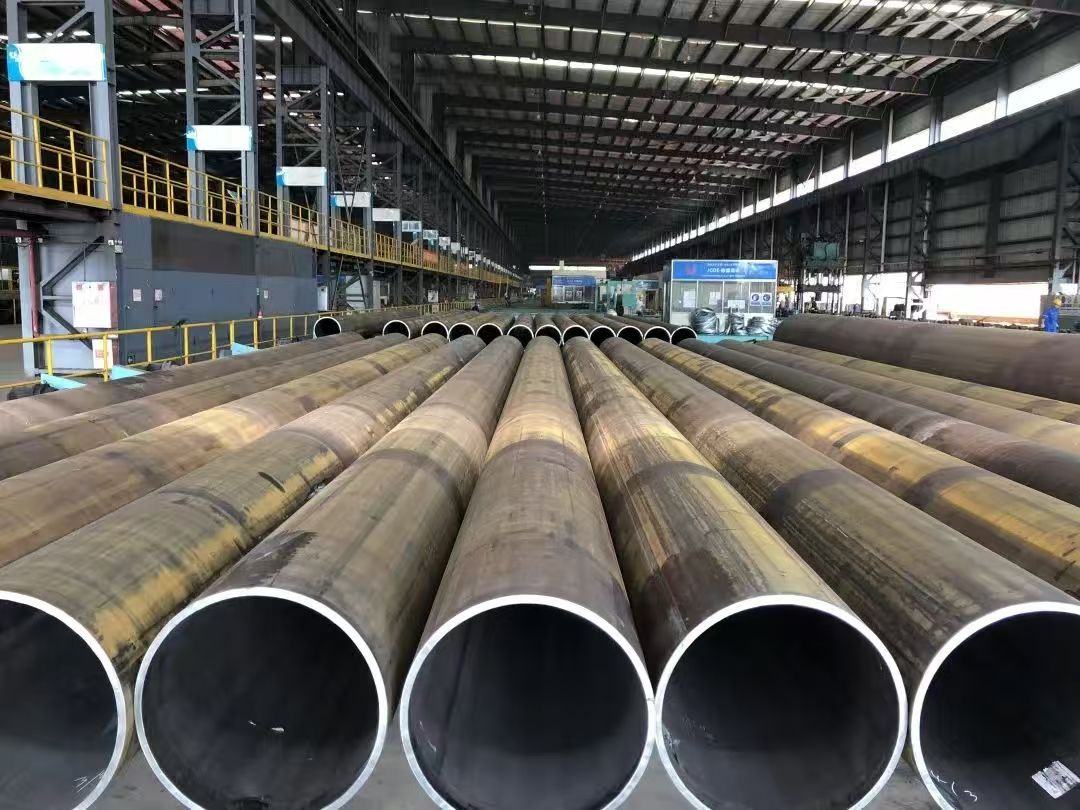
7. Quality Control & Testing Procedures for Piling Pipe
| Stage | Inspection Method | Purpose |
| Raw Material | Chemical Analysis (OES Spectrometer) | Verify compliance with ASTM A252 / EN 10248 composition limits |
| Raw Material | Tensile Testing | Verify yield strength, tensile strength, elongation |
| Raw Material | Ultrasonic Testing (Plate/Coil) | Detect internal laminations and defects |
| In-Process (ERW) | Dimensional Inspection (Micrometers, Calipers) | Monitor OD, WT during forming and sizing |
| In-Process (LSAW) | Edge Preparation Inspection | Verify bevel angle, landing, and surface condition |
| Weld Zone (ERW) | Ultrasonic Testing (UT) - On-Line | Detect weld discontinuities, lack of fusion |
| Weld Zone (LSAW) | Ultrasonic Testing (UT) - Automatic | Full weld seam inspection for internal/external defects |
| Weld Zone (LSAW) | Radiographic Testing (RT) | Verify weld penetration, porosity, slag inclusion |
| Weld Zone | Magnetic Particle Inspection (MPI) | Surface crack detection (weld and HAZ) |
| Finished Pipe | Dimensional Inspection | Verify OD, WT, length, straightness, roundness |
| Finished Pipe | Hydrostatic Testing (Optional) | Verify pressure integrity for critical applications |
| Finished Pipe | Guided Bend Test | Verify weld ductility and soundness |
| Finished Pipe | Flattening Test (ERW only) | Verify ductility and soundness of pipe body |
| Finished Pipe | Charpy V-Notch Impact Test (Optional) | Verify low-temperature toughness for marine use |
| Finished Pipe | Hardness Test (Optional) | Verify maximum hardness for weldability |
| Finished Pipe | Visual & Surface Inspection | Check for surface defects, laminations, cracks |
| Finished Pipe | Marking Verification | Ensure permanent marking per standard |
Optional Tests for Critical Marine & Offshore Applications:
● CTOD (Crack Tip Opening Displacement) Test for fracture toughness
● HIC (Hydrogen Induced Cracking) Test per NACE TM0284
● SSC (Sulfide Stress Cracking) Test per NACE TM0177
● Hardness Testing (HV10 or HRC) for sour service qualification
Quality Documentation:
● Mill Test Certificate per EN 10204 Type 2.2, 3.1, or 3.2
● Ultrasonic Test Report (weld and body)
● Radiographic Test Report (if specified)
● Dimensional Inspection Report
● Traceability from heat number to finished pipe
8. Primary Applications - Marine Steel Piling Pipe
ASTM A252 GR.3 and EN 10248 S355GP marine steel piling pipes are essential components in deep foundation, marine construction, and heavy civil engineering projects:
Deep Foundation Piling: Load-bearing piles for high-rise buildings, bridges, industrial facilities, and heavy structures requiring deep foundation support. The high strength of GR.3 and S355GP allows for deeper driving depths and higher load capacity.
Marine & Offshore Platform Foundation: Foundation piles for offshore oil and gas platforms, drilling rigs, production platforms, and offshore wind turbine foundations. Marine piling must withstand wave action, current forces, and corrosive seawater environment.
Wharf, Dock & Port Construction: Piling for container terminals, bulk cargo ports, passenger terminals, Ro-Ro facilities, and general cargo wharves. Piles provide structural support for deck structures, mooring dolphins, and breasting dolphins.
Bridge Foundation & Pier: Deep foundation piles for bridge piers, abutments, and tower foundations for cable-stayed and suspension bridges. Piles transfer structural loads to competent bearing strata.
Coastal Protection & Seawall: Piling for seawall structures, coastal revetments, shoreline protection, and erosion control. Steel pipe piles provide robust structural support for armor units and concrete cap structures.
Breakwater & Jetty Construction: Piling for rubble mound breakwater foundations, vertical wall breakwaters, jetties, and groynes. Piles provide foundation stability for wave-dissipating structures.
Fender System Support: Support piles for marine fender systems at dock faces and berthing structures. Piles absorb berthing energy and protect vessel and structure during mooring operations.
Jacket Pile for Oil & Gas Platform: Piling for jacket structures supporting oil and gas production platforms. Large-diameter, thick-wall piles are driven through jacket legs and grouted in place.
Land Reclamation & Reclamation Seawall: Piling for reclamation area containment structures, perimeter seawalls, and reclamation bunds. Piles provide structural integrity for land extension projects.
River Training & Flood Control: Piling for riverbank protection, guide banks, spurs, and flood control structures. Steel pipe piles stabilize riverbanks and protect against scour and erosion.
Tunnel Engineering & Cut-and-Cover: Piling for cut-and-cover tunnel foundations, secant pile walls, and tunnel portal support structures. Piles provide vertical and lateral support for underground structures.
Seismic Retrofit Foundation: Piling for seismic retrofit of existing structures, including bridge foundations, building foundations, and port structures requiring enhanced earthquake resistance.
9. Packaging & Shipping - Marine Steel Piling Pipe
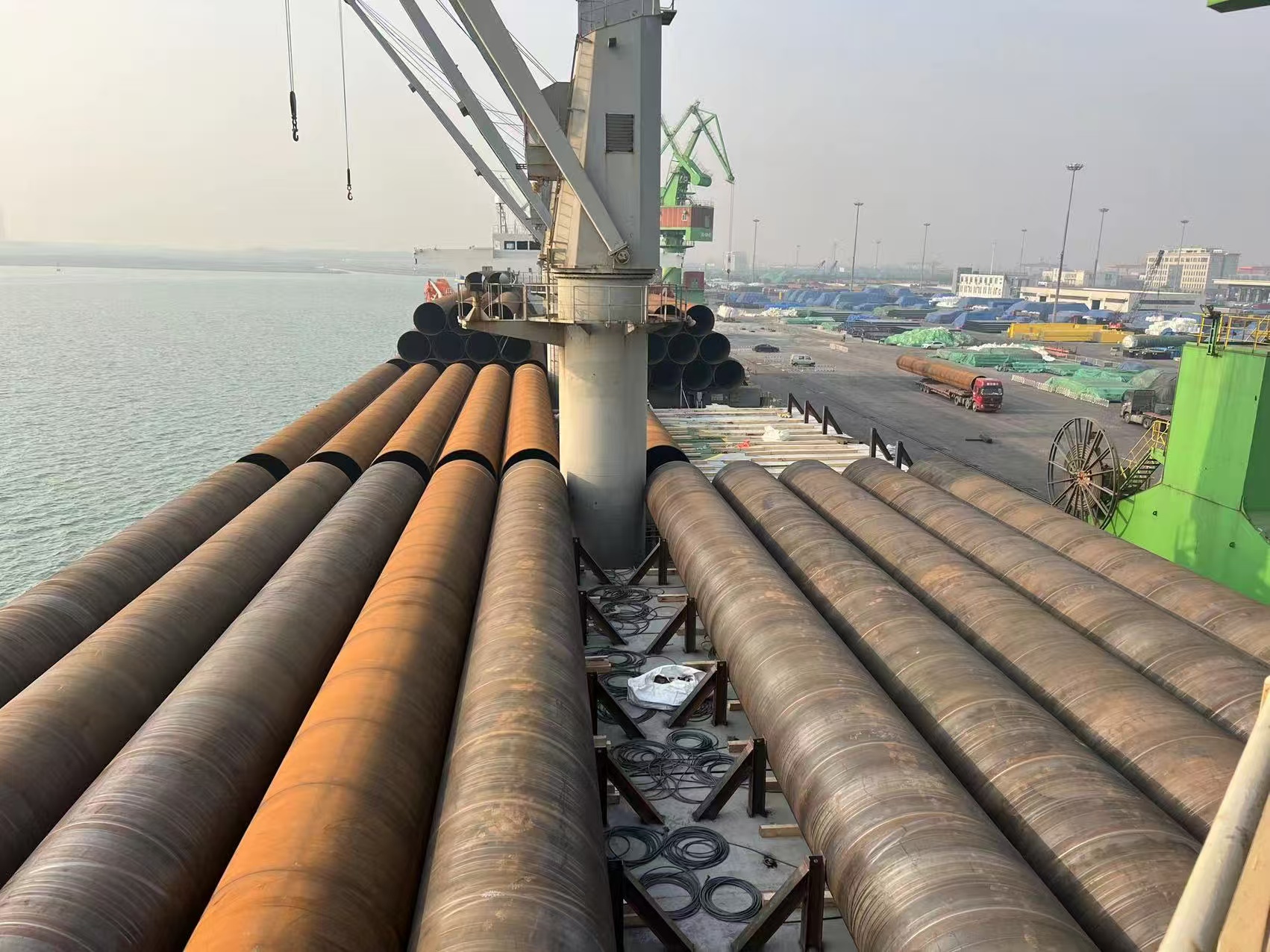
ASTM A252 GR.3 and EN 10248 S355GP marine steel piling pipes are packaged and shipped with utmost care to ensure their protection during transit. Here is a description of the packaging and shipping process for large-diameter piling pipes:
Packaging:
Protective Coating: Before packaging, pipes may be coated with a thin layer of anti-rust oil or protective varnish to prevent surface corrosion and oxidation during storage and transit. Bare finish also available for immediate coating application at destination or for marine environments where corrosion allowance is specified.
Bundling (Small Diameters): For smaller diameter pipes (typically below 610mm / 24"), pipes are bundled together in hexagonal or rectangular bundles. They are secured using steel straps (typically 3-5 straps per bundle with protective corner guards) to prevent movement within the bundle.
Individual Stacking (Large Diameters): For larger diameter pipes (above 610mm / 24"), pipes are typically handled and shipped individually due to weight and dimensional constraints. Wooden dunnage or rubber padding placed between pipe layers prevents abrasion and coating damage.
End Caps: Plastic or steel end caps are placed on both ends of each pipe (or plastic wrap for beveled ends) to protect beveled ends, plain ends, and threaded connections from impact damage, debris ingress, and moisture.
Sacrificial Steel Rings (Optional): For piling pipes requiring enhanced end protection during pile driving, sacrificial steel rings (typically 50-100mm wide, 6-12mm thick) are welded to the driving end of each pipe. These rings absorb driving hammer impacts and protect the pipe end from deformation.
Padding and Cushioning: For premium export orders, padding materials such as foam rings, rubber strips, or wood dunnage are used between pipe layers to prevent abrasion, coating damage, and impact damage during handling and transit.
Lifting Points: Lifting lugs or designated lifting points may be added to heavy pipes (over 2,000 kg per pipe) to facilitate safe unloading at destination using crane or forklift.
Shipping:
Mode of Transportation: Pipes are shipped via container vessels (20ft or 40ft containers for small diameters), bulk carriers (break bulk for large diameters and large volumes), or rail freight, depending on destination, order volume, and delivery urgency. Project cargo vessels may be used for very large diameter or extra-long pipes.
Containerization (Small Diameters): For smaller diameter pipes (typically below 508mm / 20"), pipes are loaded into standard 20ft or 40ft shipping containers to ensure safe and organized transit. Container loading protects cargo from weather conditions, moisture, and external contaminants. Maximum container load typically 20-25 tons per 20ft container.
Bulk Vessel Loading (Large Diameters & Large Volumes): For large-volume orders (typically >500 tons) or large diameter pipes (above 508mm / 20"), pipes are loaded directly into bulk carriers or geared vessels. Lifting beams and spreader bars prevent damage during loading. Dunnage, lashing, and securing chains are used to prevent cargo shifting during sea transit. This method is most cost-effective for heavy marine piling projects.
Flat Rack or Open Top Containers (Over-Height / Over-Length): For pipes exceeding standard container dimensions (length >12m or diameter >2.3m), flat rack containers or open top containers may be used for break bulk quantities. These specialized containers allow for secure transport of oversized cargo.
Labeling and Documentation: Each bundle or individual pipe is clearly labeled with essential information including material grade, standard, dimensions, heat number, bundle/pipe number, and handling instructions. Complete shipping documents are prepared for customs clearance and cargo tracking.
Customs Compliance: For international shipments, all necessary customs documentation—including commercial invoice, packing list, bill of lading, Certificate of Origin (if required), Mill Test Certificates, and any required import permits—is prepared to ensure smooth clearance at destination port.
Secure Fastening: Within the transportation vehicle or container, bundles and individual pipes are securely fastened and braced using steel strapping (with corner protectors), dunnage bags, timber bracing, or chain lashing to prevent shifting, rolling, or movement that could cause damage during transit.
Tracking and Monitoring: Advanced logistics tracking systems are employed to monitor shipment status and provide real-time location updates to customers. Container tracking numbers provided for all container shipments. Vessel tracking available for bulk shipments.
Insurance: Depending on order value and customer requirements, marine cargo insurance (All Risk or With Average coverage) may be arranged to cover potential losses or damages during transit. For high-value marine piling projects, additional rigging and installation insurance may be recommended.
Heavy Lift Planning: For extra-heavy pipes (over 5,000 kg per pipe), advance coordination with destination port for heavy lift handling equipment (cranes with sufficient capacity, specialized spreader bars) is recommended. Womic Steel provides detailed cargo specifications including individual pipe weights and dimensions for project planning.
In summary, Womic Steel ensures that all ASTM A252 GR.3 and EN 10248 S355GP marine steel piling pipes are packaged with industry-leading protective measures and shipped using reliable transportation methods to reach their destination in optimal condition. Proper packaging and shipping procedures are essential to preserving the integrity and quality of the delivered products, especially for critical marine foundation projects.
10. Womic Steel Advantages & FAQ - Marine Steel Piling Pipe
Why Partner with Womic Steel for Marine Piling Pipe?
Complete Range of Processes & Sizes: Both ERW (219mm-660mm OD) and LSAW/SSAW (508mm-3,000mm OD) processes available under one roof, eliminating the need for multiple suppliers. Wall thickness up to 50.8mm and lengths up to 60m available for deep foundation projects.
Dual Standard Capability: Full compliance with both ASTM A252 (GR.1, GR.2, GR.3) and EN 10248 (S235GP, S275GP, S355GP) standards, plus supplementary standards (API 5L, EN 10219, JIS A5525, etc.). One supplier for multiple market requirements.
Marine & Offshore Focus: Specialized experience in marine and offshore piling applications including port construction, offshore platforms, bridge foundations, and coastal protection projects. Understanding of marine corrosion protection and driving stress requirements.
Sacrificial Steel Rings: In-house welding of sacrificial steel rings to pipe driving ends for enhanced protection during pile driving operations, reducing pipe end deformation and installation delays.
Value-Added Services: End beveling (30°-35°), plain end cutting, protective coating (FBE, 3LPE, Coal Tar Epoxy, Galvanizing), and anti-corrosion wrapping available in-house or through qualified partner facilities.
Long Length Capability: Up to 60m single length for deep foundation projects, reducing field splicing requirements and installation time. Custom lengths available without extra charges for standard ranges.
Competitive Logistics: Strategic partnership with global freight forwarders and project cargo specialists ensures optimized loading (container, break bulk, or project vessel) and cost-effective worldwide shipping for heavy and oversized piling pipes.
Comprehensive Documentation: Full Mill Test Certificates (EN 10204 Type 2.2, 3.1, or 3.2), NDT reports (UT, RT), dimensional reports, and traceability documentation provided for every shipment. Third-party inspection (SGS, BV, TÜV, LR, DNV) facilitated upon request.
Choose Womic Steel Group as your reliable partner for high-quality ASTM A252 GR.3 and EN 10248 S355GP marine steel piling pipes and unbeatable delivery performance for marine, offshore, and deep foundation projects worldwide. Welcome to inquire!
Website: www.womicsteel.com
Email: sales@womicsteel.com
Tel/WhatsApp/WeChat:
Victor: +86-15575100681
Jack: +86-18390957568
Frequently Asked Questions (FAQ) - Marine Steel Piling Pipe
Q: What is the difference between ASTM A252 GR.3 and EN 10248 S355GP for marine piling?
A: ASTM A252 GR.3 (American standard) has a minimum yield strength of 345 MPa (50,000 psi), while EN 10248 S355GP (European standard) has a minimum yield strength of 355 MPa (51,500 psi). EN 10248 S355GP also has slightly more stringent chemical composition limits (lower C, P, S) and optional low-temperature impact testing requirements. Both are suitable for marine piling applications. The choice typically depends on project specification and regional standard preference. For projects in Americas and Asia following API/ASTM standards, GR.3 is preferred. For European, Middle Eastern, and African projects, S355GP is commonly specified.
Q: Which manufacturing process should I choose for my piling pipe project - ERW or LSAW?
A: For outside diameters up to 660mm (26 inches), ERW is generally more cost-effective and offers faster production lead times. For diameters from 508mm to 3,000mm (20 to 120 inches), LSAW is required as ERW technology cannot produce these larger diameters. For diameters above 3,000mm (120 inches), SSAW (spiral welded) may be considered. Wall thickness requirements also influence process selection - LSAW can achieve thicker walls (up to 50.8mm) compared to ERW (typically up to 25.4mm). Womic Steel can advise on the optimal process based on your specific dimensional requirements and project budget.
Q: What is a sacrificial steel ring and when should it be used?
A: A sacrificial steel ring is a short steel section (typically 50-100mm wide, 6-12mm thick, matching pipe OD) welded to the driving end of a piling pipe. It absorbs impact energy from the pile driving hammer, protecting the pipe end from deformation, buckling, or cracking. Sacrificial rings are recommended for:
● Hard driving conditions (dense sand, gravel, rock sockets)
● Heavy pile driving hammers (high energy impact)
● Thin-wall pipes (diameter-to-thickness ratio > 50)
● Critical projects where pipe end damage would cause schedule delays
● Pipes requiring watertightness after driving
Q: What length options are available for marine piling pipe? Can you supply extra-long lengths to reduce field splicing?
A: Standard lengths are 6m, 12m, and 18m. For deep foundation and marine projects, we supply custom lengths up to 60m (200 feet) depending on diameter and wall thickness. Extra-long lengths offer significant advantages: reduced number of field splices (lower installation cost, faster schedule), improved structural continuity, and reduced risk of weld defects. However, longer lengths require specialized transport (flat rack containers, bulk vessels, or project cargo) and may have higher logistics costs. We recommend optimizing length based on project requirements, transport options, and site access constraints. Please provide your project details for specific length availability and lead time.
Q: What coating options are available for marine piling pipe to protect against seawater corrosion?
A: We offer multiple anti-corrosion coating options for marine environments:
FBE (Fusion Bonded Epoxy): Single or dual layer, excellent adhesion and cathodic disbondment resistance, typical thickness 300-500 microns.
3LPE / 3LPP (Three Layer Polyethylene / Polypropylene): Superior mechanical protection and corrosion resistance, typical thickness 2.0-4.5mm, suitable for aggressive marine environments.
Coal Tar Epoxy: Excellent water resistance and cathodic protection compatibility, typical thickness 300-600 microns.
Hot Dip Galvanizing: Zinc coating (typically 85-100 microns), provides sacrificial protection at coating damage points.
Liquid Epoxy: Field-applied coating for touch-up and repair.
Concrete Weight Coating (CWC): For submerged pipelines requiring negative buoyancy.
For most marine piling applications, 3LPE or FBE coating combined with cathodic protection (sacrificial anodes or impressed current) is the industry standard. Coating selection depends on seawater conditions (temperature, salinity, oxygen content), design life (20-50 years), and project budget.
Q: Can you supply piling pipe with third-party inspection (SGS, BV, TÜV, DNV, LR)?
A: Yes. We welcome and facilitate inspections by DNV, BV, SGS, TÜV, ABS, LR, or any client-nominated representative during production (witnessing raw material testing, dimensional inspection, NDT, and final inspection) and prior to shipment. 3.2 inspection certificates validated by authorized third-party bodies are routinely supplied upon request. For offshore and marine projects requiring classification society approval (DNV, ABS, LR, BV), we coordinate directly with the society for surveyor attendance and documentation approval.
Q: What non-destructive testing (NDT) is required for marine piling pipe?
A: For ASTM A252 GR.3, standard NDT requirements are limited (no mandatory NDT for standard grade). However, for critical marine and offshore applications, we recommend and can provide:
100% Ultrasonic Testing (UT) of weld seam and pipe body (for LSAW and ERW)
Magnetic Particle Inspection (MPI) of weld toes and heat-affected zone
Radiographic Testing (RT) of weld seam (spot or full length)
Laminar UT scanning of plate edges before welding (for LSAW)
For EN 10248 S355GP, supplementary testing including UT or MPI may be specified by the purchaser. We always recommend discussing NDT requirements at quotation stage to ensure proper testing scope and documentation.
Q: What is the maximum single length you can supply for large diameter piling pipe (e.g., 2,000mm OD × 25mm WT)?
A: For 2,000mm OD × 25mm WT, we can supply single lengths up to 24m (approximately 80 feet) for LSAW process. For diameters above 1,500mm, maximum length is typically limited by plate size availability and transport constraints. Please contact us with your specific dimensional requirements (OD, WT, length, quantity) for a detailed capability assessment and lead time quotation. For projects requiring lengths beyond standard transport limits (e.g., >24m for large diameters), we can assist with project logistics planning including barge or special transport arrangements.
Q: Do you provide cut-to-length services for piling pipe? What tolerances can you achieve?
A: Yes. We offer precision cutting to exact customer-specified lengths with tight tolerances. Standard length tolerance is +50mm / -0mm per ASTM A252 and EN 10248 requirements. For projects requiring closer tolerances, we can achieve ±3mm for diameters up to 660mm (ERW) and ±5mm for larger diameters (LSAW) with additional processing. Cutting can be followed by end beveling (30°-35° bevel angle with 1.6mm ±0.8mm landing) for field butt welding or plain end finishing as required. Please specify your tolerance requirements at quotation stage.
Q: What is the typical lead time for ASTM A252 GR.3 or EN 10248 S355GP marine piling pipe?
A: Standard lead times for mill-produced piling pipe (not from stock) are approximately 30-45 days for ERW process and 45-60 days for LSAW process, depending on order quantity, diameter, wall thickness, and specific testing requirements. Rush orders (20-30 days) may be available for smaller quantities or for standard sizes produced from stock materials. For projects requiring third-party inspection (SGS, BV, DNV, etc.), add 5-10 days for inspection scheduling and documentation. For coating (FBE, 3LPE, etc.), add 10-20 days depending on coating type and quantity. Please contact us with your project timeline for current lead time quotation.
Q: What documentation is provided with each shipment of marine piling pipe?
A: Each shipment includes comprehensive documentation:
Mill Test Certificate (MTC): per EN 10204 Type 3.1 (or Type 2.2 / 3.2 upon request) including chemical composition, tensile properties, and applicable test results
Dimensional Inspection Report: including OD, WT, length, straightness, roundness
Non-Destructive Testing Reports: UT reports (weld and body), RT reports (if specified), MPI reports
Traceability Documentation: heat number to finished pipe traceability records
Packing List: detailed bundle/pipe list with quantities, dimensions, and weights
Commercial Invoice & Packing Declaration: for customs clearance
Certificate of Origin: if required by destination country (C/O, Form E, or other)
Coating Reports: if coating applied (thickness, adhesion, holiday detection)
For EN 10248 S355GP, additional documentation including CE marking declaration and Declaration of Performance (DoP) may be provided upon request.
Related Products
-

ASTM A312 TP316H Welded Stainless Steel Pipe: M...
-

ASTM A790 S32760 Super Duplex Stainless Steel W...
-

ASTM A312 TP310S / TP310H Welded Stainless Stee...
-

ASTM A790 S32750 Super Duplex Stainless Steel W...
-

ASTM A312 TP309 / TP309H Welded Stainless Steel...
-

ASTM A790 S31803 Duplex Stainless Steel Welded ...
-

ASTM A312 TP304N Welded Stainless Steel Pipe: M...
-

ASTM A790 / A789 S32205 Duplex Stainless Steel ...
-

ASTM A312 TP304/304L Welded Stainless Steel Pipe