


What ASTM A691 2.25Cr CL22 Means
ASTM A691 covers carbon and alloy steel pipe, electric-fusion-welded with filler metal added, fabricated from pressure-vessel-quality plate, suitable for high-pressure service at high temperatures. The designation breaks into three parts.
Grade 2.25Cr identifies the base plate. This grade corresponds to ASTM A387 Gr.22, a chromium-molybdenum alloy steel plate designed for elevated-temperature service. The 2.25% chromium content provides oxidation resistance and elevated-temperature strength, while the 1% molybdenum contributes creep resistance and hardenability. The pipe’s chemistry and mechanical properties follow the A387 Gr.22 plate specification.
Class 22 defines heat treatment and testing. Class 22 requires the pipe to be stress relieved after welding, the longitudinal weld seam to be radiographically examined, and the finished pipe to undergo hydrostatic testing. This class provides PWHT and full RT without the normalization or quenching-and-tempering required by higher classes.
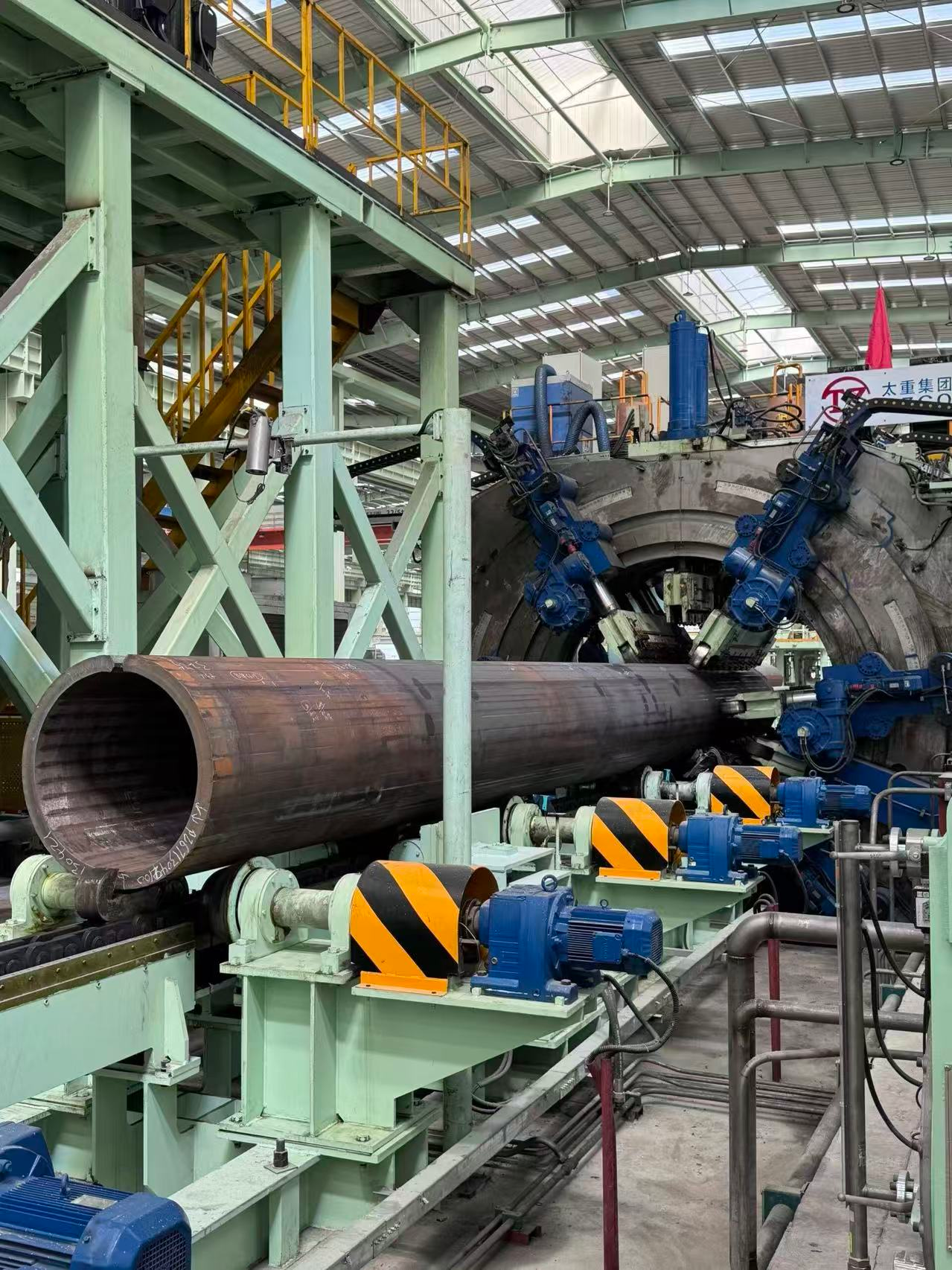
EFW indicates the manufacturing method: alloy steel plate is formed into cylindrical shape, and the longitudinal seam is welded using submerged arc welding (SAW) with filler metal added.
Chemical and Mechanical Properties
Because 2.25Cr is tied to A387 Gr.22 plate, the finished pipe‘s chemistry and strength follow that plate standard.
| Property | Typical Value |
| Carbon | 0.05–0.15% |
| Manganese | 0.30–0.60% |
| Phosphorus (max) | 0.025% |
| Sulfur (max) | 0.025% |
| Silicon | 0.50% max |
| Chromium | 2.00–2.50% |
| Molybdenum | 0.90–1.10% |
| Yield Strength (min) | 310 MPa |
| Tensile Strength | 515–690 MPa |
| Elongation (min) | 18% |
| Max Operating Temperature | 565–593°C |
Actual test results on the mill certificate reflect the specific heat and plate used. Class 22 stress relieving does not alter the base chemistry.
Grade Comparison: 1.25Cr vs 2.25Cr vs 5Cr
Buyers searching 2.25Cr often compare it against the neighboring chrome-moly grades. The difference is chromium and molybdenum content, which drives elevated-temperature strength, oxidation resistance, and resistance to hydrogen attack.
| Grade | Base Plate | Cr Content | Mo Content | Typical Use |
| 1.25Cr | A387 Gr.11 | 1.00–1.50% | 0.45–0.65% | General high-temp steam and process lines |
| 2.25Cr | A387 Gr.22 | 2.00–2.50% | 0.90–1.10% | Higher temperature, hydrogen service, power plant piping |
| 5Cr | A387 Gr.5 | 4.00–6.00% | 0.45–0.65% | Refinery service with sulfur and hydrogen |
2.25Cr is selected over 1.25Cr when the operating temperature or hydrogen partial pressure exceeds what 1.25Cr can tolerate. It is selected over 5Cr when the service does not require the higher chromium content for sulfidation resistance, since 2.25Cr is more economical and easier to weld.
Class 22 vs Other A691 Classes
| Class | Heat Treatment | Radiography | Hydrotest | Typical Specification |
| 12 | None | Full RT | Yes | As-welded, moderate service |
| 22 | Stress Relieved | Full RT | Yes | High-temp service with PWHT |
| 32 | Normalized | Full RT | Yes | Higher toughness demand |
| 42 | Normalized + Tempered | Full RT | Yes | Severe service, critical high-temp |
For critical high-temperature piping, Class 42 is often the standard requirement in EPC specifications. Class 22 is appropriate where stress relieving is sufficient and normalized plate properties are not required by the design code.
Size Range and Manufacturing Options
Womic produces A691 2.25Cr CL22 pipe using LSAW with either single straight seam or double straight seam configuration. ASTM A691 nominally covers pipe 16 inches (400 mm) outside diameter and larger with wall thicknesses up to 3 inches (75 mm).
| Parameter | Range |
| Outside Diameter | 16″ to 100″ (400 mm to 2,540 mm) |
| Wall Thickness | 6 mm to 75 mm (heavier on request) |
| Length | 6 m, 12 m standard; up to 18 m or 24 m on request |
| Manufacturing Method | EFW / LSAW with filler metal |
| Seam Type | Single straight seam or double straight seam |
Single Straight Seam vs Double Straight Seam
Single straight seam is used when one plate can be rolled into a full cylinder. At Womic this covers OD up to about 1,422 mm with wall thickness up to 50.8 mm on the JCOE line. One longitudinal weld concentrates inspection on a single seam.
Double straight seam is used when diameter or wall thickness exceeds what a single plate can form. Two plates are rolled into half-cylinders and each is welded longitudinally. This covers OD from about 1,200 mm to 2,540 mm with wall thickness up to 75 mm or more. The trade-off is two weld seams to inspect, but it enables large-diameter alloy pipe that single seam cannot produce.
Welding and Heat Treatment of 2.25Cr Pipe
The longitudinal seam is welded by submerged arc welding with filler metal selected to match the 2.25Cr base metal. The higher chromium and molybdenum content compared to 1.25Cr makes 2.25Cr more sensitive to cracking in the heat-affected zone if welding and cooling are not controlled. Preheating, interpass temperature control, and post-weld heat treatment are all more critical for this grade.
After welding, the pipe is stress relieved per Class 22 requirements: heated uniformly to a temperature below the critical range, held for a time proportional to wall thickness, and cooled in a controlled manner. This relieves residual stresses from forming and welding and stabilizes the microstructure for elevated-temperature service.
What Class 22 Testing Involves
Stress Relieving: After welding, the pipe is heated to a temperature below the critical range and held to relieve residual stresses.
Radiographic Examination: The longitudinal weld seam is examined by X-ray or gamma ray to detect internal defects. Class 22 requires full RT of the longitudinal seam.
Hydrostatic Testing: Each pipe is filled with water and pressurized to a level determined by the specified wall thickness and diameter, held for a defined period, and inspected for leaks or permanent deformation.
Supplementary requirements in ASTM A691 can be invoked for impact testing, additional radiography, or hardness testing when the project demands more than the base Class 22 scope.
Applications for A691 2.25Cr CL22 Pipe
● Power plant steam piping including main steam, hot reheat, and superheater lines where the metal temperature and pressure exceed the 1.25Cr range
● Refinery hydroprocessing units including hydrocrackers and hydrotreaters where 2.25Cr provides resistance to hydrogen attack at elevated temperature and pressure
● Large-diameter alloy headers where seamless pipe above NPS 24 is impractical or unavailable
● Petrochemical high-pressure piping in units handling hydrogen-rich streams at elevated temperature

Project Cases
Middle East Refinery Hydroprocessing Piping
A refinery project in the Middle East specified A691 2.25Cr CL22 EFW pipe for hydroprocessing unit piping. The pipe was required in OD 610 mm and 762 mm, wall thickness 25 mm and 30 mm, with full RT and PWHT per Class 22. The 2.25Cr grade was selected for its resistance to hydrogen attack at the operating temperature and hydrogen partial pressure of the hydrotreater. Production followed the same EFW route used for the 1.25Cr power station project, with the plate specification changed to A387 Gr.22 and the PWHT parameters adjusted for the higher alloy content.
Power Plant Steam Line Replacement
A power station maintenance project in Asia required A691 2.25Cr CL22 pipe for main steam line replacement. The pipe was specified in OD 508 mm × WT 25.4 mm × 12,000 mm, matching the existing 2.25Cr steam system. The project required full RT, PWHT charts, and EN 10204 3.1 certification. This type of replacement work is common for 2.25Cr piping as older power plants are maintained and upgraded.
Quality Documentation
Each shipment of A691 2.25Cr CL22 pipe from Womic Steel includes:
● EN 10204 3.1 mill test certificate with chemical composition and mechanical test results traceable to the plate heat number
● Radiographic examination report for the weld seam
● Hydrostatic test record
● Post-weld heat treatment chart with temperature and holding time
● Dimensional inspection report
● Third-party inspection available upon request (SGS, BV, TÜV)
Packaging and Shipping
Pipes are supplied with beveled ends protected by plastic caps, or plain ends as specified. The pipe surface receives a protective coating suitable for transport and storage. Small and medium diameters are bundled with steel straps; large diameters and heavy wall pipe are shipped individually with wooden dunnage. Third-party pre-shipment inspection can be arranged.
Frequently Asked Questions
Q: What is the difference between 2.25Cr and 1.25Cr in ASTM A691?
2.25Cr uses A387 Gr.22 plate with 2.00–2.50% chromium and 0.90–1.10% molybdenum, while 1.25Cr uses A387 Gr.11 plate with 1.00–1.50% chromium and 0.45–0.65% molybdenum. The higher alloy content of 2.25Cr provides better elevated-temperature strength, oxidation resistance, and resistance to hydrogen attack. 2.25Cr is selected when the operating temperature or hydrogen partial pressure exceeds what 1.25Cr can tolerate.
Q: What does Class 22 mean for A691 2.25Cr pipe?
Class 22 means the pipe is stress relieved after welding, the longitudinal weld seam receives full radiographic examination, and the finished pipe is hydrostatically tested. This class is common for high-temperature piping where PWHT is required to stabilize the weld and heat-affected zone, and where full RT is specified for weld integrity verification.
Q: Can you supply A691 2.25Cr with impact testing?
Yes. Charpy V-notch impact testing is a supplementary requirement under ASTM A691. Specify the test temperature, specimen orientation, and acceptance criteria in the purchase order. Impact testing for chrome-moly pipe is less common than for low-temperature carbon steel, but can be arranged when the project specification requires it.
Q: What is the maximum temperature for A691 2.25Cr?
The maximum operating temperature is typically cited as 565–593°C (1050–1100°F), depending on the specific design code and allowable stress basis. Above this range, oxidation and creep resistance become limiting, and higher chromium grades such as 5Cr or 9Cr are typically specified.
Q: Is A691 2.25Cr the same as A387 Gr.22?
Not exactly. A387 Gr.22 is a steel plate specification. A691 2.25Cr is a pipe specification that uses A387 Gr.22 plate as starting material, forms and welds it into pipe, applies the heat treatment required by the class, and performs the specified testing. The finished pipe has chemistry and strength consistent with A387 Gr.22, but the product form and testing regime are governed by A691.
Q: Should I choose single straight seam or double straight seam?
The mill selects the seam configuration based on the ordered size. Single straight seam covers OD up to about 1,422 mm and wall thickness up to 50.8 mm at Womic. Double straight seam covers larger diameters and heavier walls. If your project specification restricts the seam type, state this in the purchase order.
Contact Womic Steel for ASTM A691 2.25Cr CL22 EFW pipe quotations. Provide the outside diameter, wall thickness, quantity, length, end finish, and any supplementary testing requirements. We will confirm availability and lead time within one business day.
Website: www.womicsteel.com
E-mail: sales@womicsteel.com
Tel / WhatsApp / WeChat:
Victor: +86 15575100681
Jack: +86 18390957568
Related Products
-

ASTM A691 1.25Cr CL22 EFW Steel Pipe: Manufactu...
-

ASTM A691 1Cr CL22 EFW Steel Pipe: The Entry-Le...
-

ASTM A671 EFW Steel Pipe: Complete Grade Guide ...
-
ASTM A691 2.25Cr CL22 EFW Steel Pipe for High-T...
-

ASTM A671 CC70 CL22 EFW Steel Pipe: Manufacturi...
-

ASTM A691 5Cr CL22 EFW Steel Pipe for Refinery ...
-

ASTM A671 CC65 CL22 EFW Steel Pipe: Manufacturi...
-

ASTM A691 9Cr CL22 EFW Steel Pipe for Power Pla...
-

ASTM A671 CC60 CL22 EFW Steel Pipe: Manufacturi...