


What ASTM A691 5Cr CL22 Means
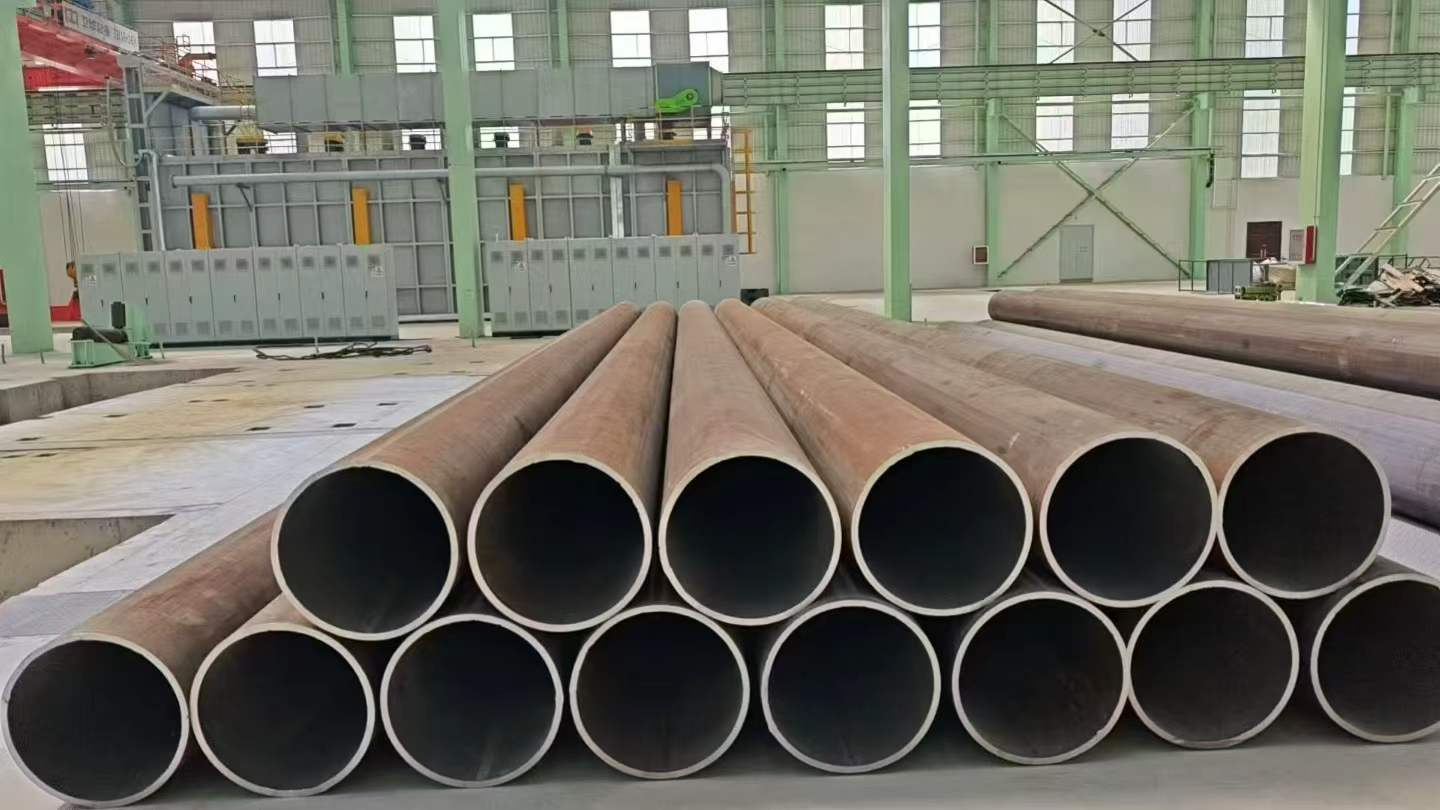
ASTM A691 covers carbon and alloy steel pipe, electric-fusion-welded with filler metal added, fabricated from pressure-vessel-quality plate, suitable for high-pressure service at high temperatures . The designation breaks into three parts.
Grade 5Cr identifies the base plate. This grade corresponds to ASTM A387 Gr.5, a chromium-molybdenum alloy steel plate with nominal chromium content of 5% and molybdenum content of 0.5% . The higher chromium content relative to 1.25Cr and 2.25Cr provides improved resistance to oxidation and, critically for refinery service, resistance to sulfidation and hydrogen attack at elevated temperatures.
Class 22 defines heat treatment and testing. Class 22 requires the pipe to be stress relieved after welding, the longitudinal weld seam to be radiographically examined, and the finished pipe to undergo hydrostatic testing . For 5Cr pipe, the stress relief treatment is not a formality—it is essential for metallurgical stability and must be controlled within specific temperature ranges.
EFW indicates the manufacturing method: alloy steel plate is formed into cylindrical shape, and the longitudinal seam is welded using submerged arc welding with filler metal added.
Chemical and Mechanical Properties
Because 5Cr is tied to A387 Gr.5 plate, the finished pipe’s chemistry and strength follow that plate standard.
| Property | Typical Value |
| Carbon (max) | 0.15% |
| Manganese | 0.30–0.60% |
| Phosphorus (max) | 0.025% |
| Sulfur (max) | 0.025% |
| Silicon (max) | 0.50% |
| Chromium | 4.00–6.00% |
| Molybdenum | 0.45–0.65% |
| Yield Strength (min) | 310 MPa |
| Tensile Strength | 515–690 MPa |
| Elongation (min) | 18% |
The chemistry and mechanical values are representative for A387 Gr.5 plate and finished A691 5Cr pipe . Actual test results on the mill certificate reflect the specific heat and plate used. Class 22 stress relieving does not alter the base chemistry.
Grade Comparison: 2.25Cr vs 5Cr vs 9Cr
The chrome-moly grades in A691 form a progression of increasing chromium content, each suited to progressively more aggressive high-temperature environments.
| Grade | Base Plate | Cr Content | Mo Content | Primary Driver for Selection |
| 2.25Cr | A387 Gr.22 | 2.00–2.50% | 0.90–1.10% | Hydrogen service, power plant steam |
| 5Cr | A387 Gr.5 | 4.00–6.00% | 0.45–0.65% | Refinery sulfidation, high-temp process |
| 9Cr | A387 Gr.9 | 8.00–10.00% | 0.90–1.10% | Severe oxidation, advanced power cycles |
5Cr is selected over 2.25Cr when the process stream contains sulfur compounds that would cause excessive sulfidation of lower-chromium steel at the operating temperature. It is selected over 9Cr when the service does not require the higher chromium content of 9Cr for oxidation resistance, since 5Cr is more economical and has a longer track record in refinery applications.
Class 22 and the Critical Role of PWHT for 5Cr Pipe
Class 22 requires stress relieving after welding, full radiographic examination of the longitudinal seam, and hydrostatic testing . For 5Cr pipe, the post-weld heat treatment (PWHT) is the most critical step in the manufacturing sequence.
5Cr-0.5Mo steel is sensitive to cracking in the heat-affected zone if welding and cooling are not properly controlled. The material requires PWHT to temper the hard microstructures formed during welding and to relieve residual stresses. However, the PWHT parameters must be carefully selected. Research on 5Cr-0.5Mo welded joints has shown that intensive PWHT—either at excessive temperature or for excessive holding time—can actually accelerate the degradation process by promoting carbide formation at grain boundaries, similar to what occurs during long-term service at elevated temperature . This means the PWHT temperature range and holding time must be specified and controlled within the limits appropriate for the specific chemistry and wall thickness, not simply “as hot as possible for as long as possible.”
For A691 5Cr pipe, the stress relief temperature range is typically in the 650–760°C range, depending on the specific plate chemistry and the design code’s requirements . The PWHT chart should be included in the quality documentation so the purchaser can verify that the treatment fell within the specified window.
Size Range and Manufacturing Options
Womic produces A691 5Cr CL22 pipe using LSAW with either single straight seam or double straight seam configuration. ASTM A691 nominally covers pipe 16 inches (400 mm) outside diameter and larger with wall thicknesses up to 3 inches (75 mm) .
| Parameter | Range |
| Outside Diameter | 16″ to 100″ (400 mm to 2,540 mm) |
| Wall Thickness | 6 mm to 75 mm (heavier on request) |
| Length | 6 m, 12 m standard; up to 18 m or 24 m on request |
| Manufacturing Method | EFW / LSAW with filler metal |
| Seam Type | Single straight seam or double straight seam |
Single Straight Seam vs Double Straight Seam
Single straight seam is used when one plate can be rolled into a full cylinder. At Womic this covers OD up to about 1,422 mm with wall thickness up to 50.8 mm on the JCOE line. One longitudinal weld concentrates inspection on a single seam.
Double straight seam is used when diameter or wall thickness exceeds what a single plate can form. Two plates are rolled into half-cylinders and each is welded longitudinally. This covers OD from about 1,200 mm to 2,540 mm with wall thickness up to 75 mm or more.
Applications for A691 5Cr CL22 Pipe
The 5Cr grade is most strongly associated with refinery service where sulfidation resistance is the governing material selection criterion.
Refinery reforming and visbreaking units—5Cr-0.5Mo steel pipe is widely used in the reforming and visbreaking units of oil refineries, where operating temperatures of 400–500°C are typical and the process stream contains sulfur compounds
High-temperature transfer lines in refineries carrying process fluids that would cause excessive corrosion of carbon steel or 2.25Cr piping
Power plant piping where the operating temperature and flue gas environment require higher oxidation resistance than 2.25Cr can provide
Petrochemical units handling sulfur-bearing streams at elevated temperature and pressure
Quality Documentation
Each shipment of A691 5Cr CL22 pipe from Womic Steel includes:
● EN 10204 3.1 mill test certificate with chemical composition and mechanical test results traceable to the plate heat number
● Radiographic examination report for the weld seam
● Hydrostatic test record
● Post-weld heat treatment chart with temperature range, holding time, and cooling method
● Dimensional inspection report
● Third-party inspection available upon request (SGS, BV, TÜV)
Packaging and Shipping
Pipes are supplied with beveled ends protected by plastic caps, or plain ends as specified. The pipe surface receives a protective coating suitable for transport and storage. Small and medium diameters are bundled with steel straps; large diameters and heavy wall pipe are shipped individually with wooden dunnage. Third-party pre-shipment inspection can be arranged.
Frequently Asked Questions
Q: What is the difference between 5Cr and 2.25Cr in ASTM A691?
5Cr uses A387 Gr.5 plate with 4.00–6.00% chromium, while 2.25Cr uses A387 Gr.22 plate with 2.00–2.50% chromium. The higher chromium content of 5Cr provides significantly better resistance to sulfidation and oxidation at elevated temperature. 5Cr is selected when the process stream contains sulfur compounds that would cause unacceptable corrosion of 2.25Cr steel, which is common in refinery reforming and visbreaking units.
Q: Why is PWHT so important for 5Cr pipe?
5Cr-0.5Mo steel forms hard, crack-susceptible microstructures in the heat-affected zone during welding. PWHT tempers these structures and relieves residual stress. However, the PWHT must be controlled within the correct temperature and time window. Research has shown that excessive PWHT can promote carbide formation at grain boundaries and accelerate degradation, so the heat treatment parameters must be specified and verified, not left to the mill’s discretion .
Q: What does Class 22 mean for A691 5Cr pipe?
Class 22 means the pipe is stress relieved after welding, the longitudinal weld seam receives full radiographic examination, and the finished pipe is hydrostatically tested. For 5Cr pipe, the stress relief component of Class 22 is essential, and the PWHT chart should be reviewed as part of the documentation package.
Q: Can you supply A691 5Cr with impact testing?
Yes. Charpy V-notch impact testing is a supplementary requirement under ASTM A691. Specify the test temperature, specimen orientation, and acceptance criteria in the purchase order. Impact testing for 5Cr pipe is less common than for low-temperature carbon steel grades, but can be arranged when the project specification requires it.
Q: What is the maximum temperature for A691 5Cr?
The maximum operating temperature depends on the specific design code and the corrosivity of the process stream. In refinery service, 5Cr piping is commonly used in the 400–500°C range. Above this range, oxidation and creep become limiting, and higher chromium grades such as 9Cr may be required.
Q: Is A691 5Cr the same as A387 Gr.5?
Not exactly. A387 Gr.5 is a steel plate specification. A691 5Cr is a pipe specification that uses A387 Gr.5 plate as starting material, forms and welds it into pipe, applies the heat treatment required by the class, and performs the specified testing. The finished pipe has chemistry and strength consistent with A387 Gr.5, but the product form and testing regime are governed by A691.
Contact Womic Steel for ASTM A691 5Cr CL22 EFW pipe quotations. Provide the outside diameter, wall thickness, quantity, length, end finish, and any supplementary testing requirements. We will confirm availability and lead time within one business day.
Website: www.womicsteel.com
E-mail: sales@womicsteel.com
Tel / WhatsApp / WeChat:
Victor: +86 15575100681
Jack: +86 18390957568
Related Products
-

ASTM A691 1.25Cr CL22 EFW Steel Pipe: Manufactu...
-

ASTM A691 1Cr CL22 EFW Steel Pipe: The Entry-Le...
-

ASTM A671 EFW Steel Pipe: Complete Grade Guide ...
-

ASTM A691 2.25Cr CL22 EFW Steel Pipe for High-T...
-

ASTM A671 CC70 CL22 EFW Steel Pipe: Manufacturi...
-
ASTM A691 5Cr CL22 EFW Steel Pipe for Refinery ...
-

ASTM A671 CC65 CL22 EFW Steel Pipe: Manufacturi...
-

ASTM A691 9Cr CL22 EFW Steel Pipe for Power Pla...
-

ASTM A671 CC60 CL22 EFW Steel Pipe: Manufacturi...