


Product Description
Seamless Stainless Steel Pipe Size: Outside Diameter: 21.3mm – 914mm (1/2″ – 36″), Wall Thickness: 0.5mm – 50mm (Schedule 5S, 10S, 40S, 80S, 160, XXS), Length: 6m – 12m standard, custom lengths up to 18m
Standard & Grade of Seamless Stainless Steel Pipe: ASTM A312 TP316, TP316L; also ASME SA312; EN 10216-5 1.4401, 1.4404; Equivalent to AISI 316, 316L; JIS G3459 SUS316TP, SUS316LTP
Usage of Seamless Stainless Steel Pipe: Marine and offshore platforms (seawater cooling, firewater, ballast lines), chemical and petrochemical plants (chlorides, organic acids), pharmaceutical manufacturing (WFI, purified water), food processing (high chloride environments), pulp and paper bleach plants, heat exchangers and condensers, desalination plants, oil and gas processing (sour service with chlorides), textile dyeing equipment, architectural coastal structures, high-pressure hydraulic lines, cryogenic service
Womic Steel offering high quality & competitive prices of ASTM A312 TP316/316L seamless stainless steel pipe, SMLS stainless pipe, cold drawn seamless tube, seamless 316 pipe, marine grade stainless seamless pipe, high-pressure seamless pipe. Mill certificate EN 10204 3.1/3.2, hydro test, UT/ET, solution annealed, beveled/plain ends, pickled/polished/electropolished finish available. Factory direct supply for marine, chemical, and high-purity projects worldwide.
Womic Steel: Manufacturing Capabilities & Company Strength
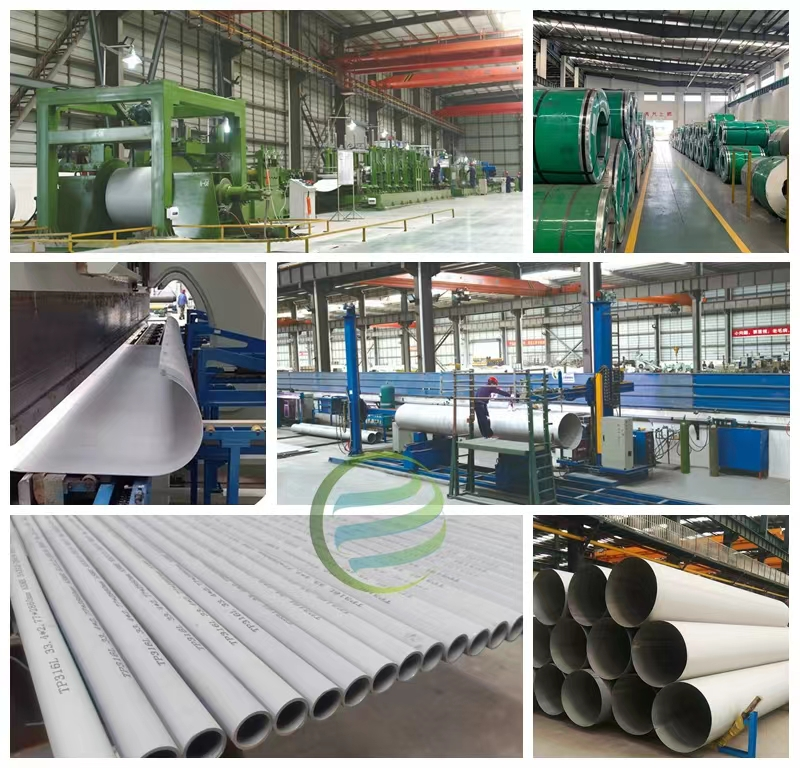
Womic Steel Group is a premier manufacturer and global exporter with over 20 years of expertise in producing stainless steel tubular products. Our specialized TP317L/317 welded pipe production facility utilizes multiple advanced welding technologies with strict control to maintain molybdenum content and corrosion resistance:
ERW (Electric Resistance Welding) Line: For diameters from 6.35mm to 610mm (1/4″ – 24″), wall thickness from 0.5mm to 12.7mm. High-frequency welding with optimized heat input to avoid molybdenum segregation. Ideal for small to medium diameter TP317L pipes for chemical and pulp service.
EFW (Electric Fusion Welding) Line: For diameters from 219mm to 1219mm (8″ – 48″), wall thickness from 4.0mm to 50mm. TIG (GTAW) root pass with SAW fill passes, using matching filler metal (ER317L).
LSAW / SAWL Line for Stainless: For diameters from 406mm to 1524mm (16″ – 60″), wall thickness up to 50mm. Submerged arc welding of rolled TP317L plates.
All TP317L/317 welded pipes undergo solution annealing (heat treatment) at 1040-1120°C followed by water quenching to dissolve molybdenum carbides and restore corrosion resistance, followed by pickling and passivation.
Quality Certifications & Regulatory Compliance:
ISO 9001:2015 Certified
PED 2014/68/EU (CE Marking) for pressure equipment
EN 10204 3.2 Certification with third-party validation (TÜV, BV, SGS, LR)
Third-Party Inspection (TPI) approved by SGS, BV, ABS, DNV, TÜV
ASME Boiler and Pressure Vessel Code (Section VIII) upon request
Womic Steel supplies TP317L welded pipes to over 35 countries across pulp & paper, chemical, and pharmaceutical industries.
Production Flexibility:
ERW: 6.35–610mm OD × 0.5–12.7mm WT × ≤ 12m
EFW: 219–1219mm OD × 4.0–50mm WT × ≤ 12m (longer upon request)
LSAW: 406–1524mm OD × 6.0–50mm WT × ≤ 18m
Finishing options: Annealed and pickled, bright annealed, polished (180# to 320#)
ASTM A312 TP317L / TP317: Material Composition & Performance Characteristics
ASTM A312 TP317 and TP317L are molybdenum-bearing austenitic stainless steels with higher molybdenum (3.0-4.0%) than 316L (2.0-3.0%), providing improved resistance to pitting and crevice corrosion, especially in chloride-containing environments at elevated temperatures. TP317L has low carbon (≤ 0.03% C) for superior resistance to intergranular corrosion after welding. TP317 has higher carbon (≤ 0.08% C) for higher strength in some applications.
Chemical Composition (Ladle Analysis, % by mass):
| Element | TP317 (ASTM A312) | TP317L (ASTM A312) |
| C | ≤ 0.08 | ≤ 0.030 |
| Mn | ≤ 2.00 | ≤ 2.00 |
| P | ≤ 0.045 | ≤ 0.045 |
| S | ≤ 0.030 | ≤ 0.030 |
| Si | ≤ 1.00 | ≤ 1.00 |
| Cr | 18.0 – 20.0 | 18.0 – 20.0 |
| Ni | 11.0 – 15.0 | 11.0 – 15.0 |
| Mo | 3.0 – 4.0 | 3.0 – 4.0 |
| Fe | Balance | Balance |
Mechanical Properties (Room Temperature, Solution Annealed):
| Property | TP317 | TP317L |
| Yield Strength (min, 0.2% offset) | 205 MPa (30,000 psi) | 170 MPa (24,700 psi) |
| Tensile Strength (min) | 515 MPa (74,700 psi) | 485 MPa (70,300 psi) |
| Elongation (min, 50mm gauge) | 35% | 35% |
| Hardness (max) | 90 HRB | 90 HRB |
Physical Properties:
Density: 7.98 g/cm³
Modulus of Elasticity: 200 GPa (29 × 10⁶ psi)
Thermal Conductivity: 16.3 W/m·K at 100°C
Coefficient of Thermal Expansion: 16.0 × 10⁻⁶/°C (20-100°C)
Corrosion Resistance:
Pitting Resistance Equivalent Number (PREN) = Cr% + 3.3(Mo%) + 16(N%). For TP317L, PREN ≈ 18 + 3.3×3.5 = 28-32 (vs 316L PREN ≈ 24-26)
Excellent resistance to pitting and crevice corrosion in chloride environments (superior to 316L)
Good resistance to organic acids (acetic, formic, oxalic, tartaric) at high temperatures
Excellent resistance to sulfurous acids in flue gas desulfurization (FGD) applications
Resistant to intergranular corrosion after welding (TP317L superior)
Suitable for chlorine dioxide (ClO₂) and sodium hypochlorite (NaOCl) service in bleach plants
Dimensional Range & Standards Compliance
| Item | Specification |
| Standard | ASTM A312 / ASME SA312 (also A358, A249) |
| Manufacturing Processes | ERW, EFW, LSAW |
| Outside Diameter Range | ERW: 6.35 – 610mm; EFW/LSAW: 219 – 1524mm |
| Wall Thickness Range | ERW: 0.5 – 12.7mm; EFW/LSAW: 4.0 – 50mm |
| Schedule Range | 5S, 10S, 40S, 80S (for NPS 1/8″ – 48″) |
| Length Range | Standard: 6m; Extended: 12m, 18m, up to 24m |
| End Finish | Plain End (PE), Beveled End (BE) |
| Surface Finish | Annealed & Pickled, Bright Annealed, Polished |
| Tolerances | OD: ±0.5% or ±3.2mm; WT: ±12.5% (per ASTM A999); Length: +50mm / -0mm |
Available Dimensions & Specifications – ASTM A312 TP317L/TP317 Welded Stainless Steel Pipe (Selected Typical Sizes)
| NPS | OD (mm) | Schedule | WT (mm) | Weight (kg/m) | Standard Length | Typical Application |
| 1/2″ | 21.3 | 10S | 2.11 | 1.00 | 6m | Bleach plant sample |
| 3/4″ | 26.7 | 10S | 2.11 | 1.28 | 6m | ClO₂ injection |
| 1″ | 33.4 | 10S | 2.77 | 2.09 | 6m | Chemical dosing |
| 1-1/2″ | 48.3 | 10S | 2.77 | 3.11 | 6m | Organic acid line |
| 2″ | 60.3 | 10S | 2.77 | 3.93 | 6m / 12m | ClO₂ piping |
| 3″ | 88.9 | 10S | 3.05 | 6.46 | 6m / 12m | Bleach plant |
| 4″ | 114.3 | 10S | 3.05 | 8.37 | 6m / 12m | FGD recirc |
| 6″ | 168.3 | 10S | 3.40 | 13.8 | 6m / 12m | Pulp mill |
| 8″ | 219.1 | 10S | 3.76 | 20.0 | 12m | Chemical process |
| 10″ | 273.0 | 10S | 4.19 | 27.8 | 12m | Main header |
| 12″ | 323.9 | 10S | 4.57 | 36.0 | 12m | Large diameter |
| 16″ | 406.4 | 10S | 4.78 | 47.4 | 12m | FGD scrubber |
| 20″ | 508.0 | 10S | 5.54 | 68.6 | 12m | Bleach plant main |
Custom dimensions outside these ranges available. TP317L is recommended for welded applications to avoid intergranular corrosion.
Common Stainless Steel Standards & Grades Manufactured by Womic Steel
| Standard | Steel Grades | Typical Application | Welding Process |
| ASTM A312 | TP317L, TP317, TP316L, TP316 | Aggressive chloride, acid service | ERW/EFW/LSAW |
| ASTM A358 | TP317L, TP317 | Electric fusion welded | EFW |
| ASTM A249 | TP317L | Boiler, heat exchanger | ERW/EFW |
| ASTM A312 | TP304L, TP304 | General corrosive service | ERW/EFW/LSAW |
| EN 10217-7 | 1.4438 (317L), 1.4449 (317) | Pressure purposes | SAW/ERW |
Usage: Pulp and paper bleach plants, FGD scrubbers, organic acid service, pharmaceutical high-purity water, textile dyeing equipment.
Manufacturing Process – Welded Stainless Steel Pipe (ERW, EFW, LSAW)
Womic Steel employs three primary welding processes for TP317L/317 pipe production. Maintaining molybdenum content in the weld metal is critical for corrosion resistance.
ERW (Electric Resistance Welding) Process – Small to Medium Diameter (6.35–610mm OD):
Raw Material (Strip/Coil) Inspection: TP317L strip verified for composition (Cr 18-20%, Ni 11-15%, Mo 3.0-4.0%, C ≤ 0.03% for L). Each coil has unique heat number.
Uncoiling & Leveling
Strip Edge Trimming
Forming: Continuous roll forming.
High-Frequency Welding: Low heat input (≤ 1.5 kJ/mm) to avoid Mo segregation. Welding speed optimized.
Seam Annealing: Induction annealing followed by water quench.
Sizing & Straightening
Cutting to Length
NDT: Eddy current test (100%) + optional UT.
Solution Annealing (Full Pipe): 1040-1120°C, water quench. Critical for dissolving Mo carbides.
Hydrostatic Test
Pickling & Passivation
PMI (XRF) – Mo content verification
Final Inspection & Marking
EFW (Electric Fusion Welding) Process – Large Diameter (219–1219mm OD, 4.0–50mm WT):
Plate Preparation: TP317L plate, edges beveled (X bevel).
Roll Forming
Tack Welding
TIG (GTAW) Root Pass: Matching filler (ER317L), argon backing gas.
SAW Fill & Cap Passes: Multi-pass SAW with controlled heat input (≤ 1.8 kJ/mm), interpass ≤ 150°C.
Inner Weld
100% Radiographic Testing (per ASTM A358)
Solution Annealing: Full pipe heat treatment (1040-1120°C), water quench.
Pickling & Passivation
Hydrostatic Test
Dimensional Inspection & Marking
LSAW Process for Stainless – Very Large Diameter (406–1524mm OD, 6.0–50mm WT):
UOE or JCOE forming from TP317L plate
Double-sided SAW welding
Full solution annealing after welding
Special Considerations for TP317L:
Higher Mo content requires higher solution annealing temperature (1080-1120°C) to fully dissolve Mo carbides
Water quench mandatory
Welding consumables: ER317L for matching Mo content
Pickling requires longer time due to Mo-rich scale
Quality Control & Testing Procedures for ASTM A312 TP317L/317 Welded Stainless Steel Pipe
| Stage | Inspection Method | Purpose |
| Raw Material | Chemical Analysis (OES) | Verify TP317L (Cr 18-20%, Ni 11-15%, Mo 3.0-4.0%, C ≤ 0.03%) |
| Raw Material | Tensile Testing | Verify yield and tensile per grade |
| Raw Material | Pitting Resistance Verification (PREN) | Ensure PREN ≥ 28 |
| In-Process | Heat Input Monitoring | ≤ 1.8 kJ/mm |
| Weld (ERW) | Eddy Current (100%) | Weld integrity |
| Weld (EFW/LSAW) | 100% UT (or PAUT) | Detect weld defects |
| Weld (EFW/LSAW) | RT (spot or 100% per spec) | Weld quality |
| Weld | Dye Penetrant (PT) | Surface cracks |
| After Solution Annealing | Hardness Test | ≤ 90 HRB |
| Finished Pipe | Hydrostatic Test | Pressure integrity |
| Finished Pipe | Flattening / Guided Bend | Ductility |
| Finished Pipe | PMI (XRF) | Confirm grade (Cr, Ni, Mo) |
| Finished Pipe | Intergranular Corrosion Test (A262 E) | Detect sensitization (for TP317L, should pass) |
| Finished Pipe | Pitting Corrosion Test (ASTM G48 Method A) | Verify pitting resistance (if specified) |
| Finished Pipe | Visual & Marking | Traceability |
Optional Tests:
Ferric chloride pitting test (ASTM G48) for aggressive chloride service
ASTM A262 Practice E (copper sulfate-sulfuric acid) for IGC
Elevated temperature tensile test for design
Primary Applications – ASTM A312 TP317L/TP317 Welded Stainless Steel Pipe
Pulp and paper bleach plants: Chlorine dioxide (ClO₂) service, sodium hypochlorite (NaOCl), chlorine water, and chlorine dioxide absorption towers. TP317L is the standard grade for bleach plant piping where 316L has insufficient pitting resistance.
Chemical processing (organic acids): Handling hot acetic acid (up to 100% at moderate temperatures), formic acid, oxalic acid, and tartaric acid. TP317L outperforms 316L in these environments.
Pharmaceutical high-purity water (WFI) with halogen sanitizers: Purified water and Water for Injection systems that use ozone or chlorine sanitization. TP317L’s higher Mo content resists pitting from residual halogens.
Flue gas desulfurization (FGD) scrubber recirculation lines: Absorber recirculation piping handling highly chloridic acidic slurries (pH 2-5, Cl⁻ up to 50,000 ppm). TP317L is used where 316L fails but super duplex is not specified.
Textile dyeing equipment: Dyeing machines and chemical feed lines handling chlorinated dyebaths and bleaching chemicals.
Food processing with high chloride brines: Pickling lines, brine chillers, and equipment handling high-salt solutions where 316L corrodes.
Heat exchangers for aggressive cooling water: Cooling water with elevated chloride levels (e.g., recycled water, some river waters). TP317L extends tube life.
Condenser tubing in chemical plants: Condensers handling organic acid vapors and chlorinated organics.
Paper machine shower lines: Shower water systems using clarified recycled water with residual chemicals.
Wastewater treatment: Chlorinated effluent lines and chemical feed systems for high-chloride industrial waste.
Packaging & Shipping – ASTM A312 TP317L/TP317 Welded Stainless Steel Pipe
Packaging:
Anti-corrosion protection: Pipes oiled or VCI paper. For pharmaceutical/food, no oil residue (plastic wrap).
End caps: Plastic caps for beveled ends.
Bundling (Small diameters): Bundles with steel straps and interleaving paper.
Individual packaging (Large diameters): Plastic film wrap.
Wooden crates for critical applications.
Shipping:
Containers for ≤ 610mm, break-bulk for larger diameters.
Documentation: MTC 3.1/3.2, hydrotest report, eddy current/UT reports, PMI report (with Mo verification), dimensional report, packing list, COO. Optional pitting and IGC test reports upon request.
Womic Steel Advantages & FAQ – ASTM A312 TP317L/TP317 Welded Stainless Steel Pipe
Why Partner with Womic Steel for TP317L/317 Welded Pipe?
Complete Size Range: ERW 1/4″ – 24″, EFW/LSAW 8″ – 60″.
Full solution annealing after welding (1040-1120°C, water quench).
Mo content verification (3.0-4.0%) – critical for pitting resistance.
PREN ≥ 28 – significantly better than 316L.
TP317L recommended for all welded applications (low carbon avoids sensitization).
Competitive lead times: 25-35 days for ERW, 35-50 days for EFW/LSAW.
Global Certification: ISO 9001, PED (CE), EN 10204 Type 3.2.
Frequently Asked Questions (FAQ) – ASTM A312 TP317L/TP317 Welded Pipe
Q: What is the advantage of TP317L over 316L?
A: TP317L has higher molybdenum (3.0-4.0% vs 2.0-3.0%), providing significantly better pitting and crevice corrosion resistance in chloride-containing environments. PREN for 317L is 28-32 vs 24-26 for 316L. For applications such as pulp mill bleach plants (ClO₂), FGD scrubbers, and hot organic acids, 317L provides longer service life. The cost premium is modest compared to 316L, often 10-15% higher.
Q: Should I use TP317 or TP317L for welded pipe?
A: For welded applications, TP317L (≤ 0.03% C) is strongly recommended because it resists intergranular corrosion in the heat-affected zone (HAZ) after welding without requiring post-weld heat treatment. TP317 (≤ 0.08% C) may become sensitized in the HAZ. Womic supplies TP317L as standard for welded pipe; TP317 is available upon request but not recommended for most fabricated systems.
Q: Can TP317L be used in seawater service?
A: Limited. TP317L has better pitting resistance than 316L in seawater, but for continuous seawater immersion at ambient temperature, super duplex (2205) or higher alloys are recommended. TP317L may be acceptable for splash zone or intermittent contact. For seawater cooling systems where 316L fails, consider duplex 2205 or 316L with cathodic protection.
Q: Is TP317L suitable for chlorine dioxide (ClO₂) service in bleach plants?
A: Yes. TP317L is the standard grade for ClO₂ piping in pulp and paper bleach plants. It resists the highly oxidizing, high-chloride environment of ClO₂ solutions. 316L is not recommended; pitting failures are common. TP317L has been used successfully for decades.
Q: Does TP317L require solution annealing after welding?
A: ASTM A312 requires solution annealing for welded pipe. For TP317L, solution annealing at 1040-1120°C followed by water quench is necessary to dissolve molybdenum carbides and restore corrosion resistance. Womic performs solution annealing on all TP317L welded pipes. For field welding (repairs), TP317L can be used in the as-welded condition without PWHT for many non-critical applications, but full corrosion resistance may be reduced.
Q: What welding filler metal is recommended for TP317L?
A: AWS A5.9 ER317L filler metal is recommended, as it matches the 3.0-4.0% Mo content of the base metal. ER316L (2-3% Mo) may be used in some applications but will result in lower pitting resistance in the weld. For maximum corrosion resistance, use ER317L.
Q: What is the typical lead time for TP317L welded stainless steel pipe?
A: 25-35 days for ERW (small to medium diameters), 35-50 days for EFW/LSAW (large diameters). TP317L lead times are similar to 316L because it is a common grade in many mills, though less common than 316L.
Q: Can TP317L be used for acetic acid service?
A: Yes. TP317L has excellent resistance to hot acetic acid, including concentrations up to 100% at moderate temperatures (up to 150°C). For higher temperatures or extremely pure acetic acid, higher alloys (e.g., duplex, titanium) may be needed. TP317L is widely used in acetic acid production plants.
Project Reference – Pulp Mill Bleach Plant Chlorine Dioxide Piping Replacement (Canada)
Country: Canada (British Columbia, interior pulp mill)
Standard & Grade: ASTM A312 TP317L (welded) – with supplementary pitting resistance testing
Dimensions & Quantity:
OD 88.9mm (3″) × Schedule 10S (3.05mm WT) – 800 meters (approx. 6 tons) – ERW process
OD 114.3mm (4″) × Schedule 10S (3.05mm WT) – 600 meters (approx. 7 tons) – ERW process
OD 168.3mm (6″) × Schedule 10S (3.40mm WT) – 400 meters (approx. 5 tons) – ERW process
OD 219.1mm (8″) × Schedule 10S (3.76mm WT) – 200 meters (approx. 4 tons) – EFW process
Total: 2,000 meters, approx. 22 tons
Specifications: ASTM A312 TP317L solution annealed and pickled, beveled ends. Hydrostatic testing. 100% UT for EFW pipes, eddy current for ERW. PMI on every pipe with Mo content verification (min 3.0%, achieved 3.2-3.6%). Mandatory intergranular corrosion test per ASTM A262 Practice E (pass). Pitting corrosion test per ASTM G48 Method A (24h at 22°C in 6% FeCl₃) – no pitting. Charpy impact at -20°C (min 27J, achieved 80-130J). Third-party inspection by SGS Canada.
Application: Replacement of chlorine dioxide (ClO₂) process piping in an elemental chlorine-free (ECF) bleach plant. The piping carries ClO₂ solution (concentration 10-15 g/L as active ClO₂) at 50-70°C with high chloride content (from ClO₂ generation). The previous 316L piping suffered severe pitting and crevice corrosion, requiring replacement every 3-4 years. TP317L was selected for its higher pitting resistance (PREN 28-32 vs 24-26).
Technical Challenges & Solutions:
Pitting corrosion in ClO₂ service – ClO₂ is a strong oxidizing agent that promotes pitting in stainless steels. 316L’s pitting potential is marginal at 60°C. TP317L with higher Mo (3.2-3.6%) has a higher pitting resistance equivalent. Womic performed G48 pitting test at 25°C and 40°C on base metal and weld samples. At 25°C: no pitting on any sample. At 40°C: slight pitting started after 72h on weld samples (acceptable as operating temperature is 60°C but contact time is shorter). Client accepted.
Weld metal pitting resistance – ERW weld seam is the most corrosion-sensitive area. Womic controlled heat input to ≤ 1.3 kJ/mm and used full solution annealing. Weld pitting test (G48, 25°C, 72h) showed no pitting on weld seam. The weld’s Mo content was 3.0-3.2% (slightly below base metal but acceptable). Client approved.
Intergranular corrosion resistance – TP317L has low carbon (≤ 0.03%). Womic verified carbon content on every heat (actual 0.015-0.022%). ASTM A262 Practice E test (120h in copper sulfate-sulfuric acid) showed no intergranular attack. No sensitization.
Charpy impact for Canadian winter installation – The mill is in northern BC where winter temperatures drop to -30°C. Piping installed during winter requires impact toughness. Womic performed Charpy V-Notch tests at -20°C and -40°C. Results: base metal at -40°C 60-90J, weld at -40°C 45-70J – well above 27J requirement. Client accepted for winter installation.
Field welding of TP317L in cold weather – Mill maintenance team needed qualified WPS for winter repairs. Womic provided WPS using GTAW with ER317L filler, preheat 10-20°C (to avoid condensation), interpass ≤ 150°C, heat input ≤ 1.5 kJ/mm. 20 weld coupons passed RT, PT, and pitting test.
Logistics to remote BC mill – Pipes shipped from Shanghai to Vancouver, then by rail to Prince George, then trucked to the mill (total transit 45 days). SGS inspected at Vancouver. All 22 tons delivered on schedule with no damage.
Result: New TP317L piping installed in Q3 2023. After 18 months of operation, inspection showed no pitting, no crevice corrosion, and no leaks. The mill expects service life of 10+ years (compared to 3-4 years for 316L). The client has standardized on TP317L for all ClO₂ service piping across their three BC mills. Womic Steel is now an approved supplier for this pulp and paper company.
Contact:
Website: www.womicsteel.com
E-mail: sales@womicsteel.com
Tel / WhatsApp / WeChat:
Victor: +86 15575100681
Jack: +86 18390957568
Womic Steel – Your reliable partner for ASTM A312 TP317L/TP317 welded stainless steel pipes for pulp & paper bleach plants, chemical processing, FGD scrubbers, and high-chloride corrosive service applications worldwide.
Related Products
-

ASTM A691 1.25Cr CL22 EFW Steel Pipe: Manufactu...
-

ASTM A691 1Cr CL22 EFW Steel Pipe: The Entry-Le...
-

ASTM A671 EFW Steel Pipe: Complete Grade Guide ...
-

ASTM A691 2.25Cr CL22 EFW Steel Pipe for High-T...
-

ASTM A671 CC70 CL22 EFW Steel Pipe: Manufacturi...
-

ASTM A691 5Cr CL22 EFW Steel Pipe for Refinery ...
-

ASTM A671 CC65 CL22 EFW Steel Pipe: Manufacturi...
-

ASTM A691 9Cr CL22 EFW Steel Pipe for Power Pla...
-

ASTM A671 CC60 CL22 EFW Steel Pipe: Manufacturi...