


Product Description
Welded Stainless Steel Pipe Size: Outside Diameter: 6.35mm – 1,219mm (1/4″ – 48″), Wall Thickness: 0.5mm – 50mm (Schedule 5S, 10S, 40S, 80S, 160, XXS), Length: 6m – 12m standard, custom lengths up to 24m
Standard & Grade of Welded Stainless Steel Pipe: ASTM A312 TP347, TP347H; also ASME SA312; EN 10217-7 1.4550; Equivalent to AISI 347, 347H
Usage of Welded Stainless Steel Pipe: High-temperature chemical processing (425-870°C), refinery heater tubes and pigtails, catalytic reformers (Platforming units), superheater and reheater tubes, heat exchangers for hot hydrocarbon service, thermal oxidizers and incinerators, furnace components, nitric acid plant piping (corrosion resistant), aircraft exhaust systems
Womic Steel offering high quality & competitive prices of ASTM A312 TP347/TP347H welded stainless steel pipe, niobium stabilized stainless pipe, high temperature stainless tube, ERW stainless pipe, EFW stainless pipe. Mill certificate EN 10204 3.1/3.2, hydro test, UT, solution annealed, beveled/plain ends, pickled finish available. Factory direct supply for refinery, petrochemical, and high-temperature industrial projects worldwide.
Womic Steel: Manufacturing Capabilities & Company Strength
Womic Steel Group is a premier manufacturer and global exporter with over 20 years of expertise in producing carbon, stainless, and alloy steel tubular products. Our state-of-the-art stainless steel welded pipe production facility utilizes multiple advanced welding technologies:
ERW (Electric Resistance Welding) Line: For diameters from 6.35mm to 610mm (1/4″ – 24″), wall thickness from 0.5mm to 12.7mm. High-frequency welding process with online annealing. Ideal for small to medium diameter stainless pipes for general industrial applications.
EFW (Electric Fusion Welding) Line: For diameters from 219mm to 1219mm (8″ – 48″), wall thickness from 4.0mm to 50mm. TIG (GTAW) root pass with SAW fill passes. Suitable for large diameter, heavy wall stainless pipes for high-pressure and high-temperature services.
LSAW / SAWL Line for Stainless: For diameters from 406mm to 1524mm (16″ – 60″), wall thickness up to 60mm. Submerged arc welding of rolled stainless plates. Used for large diameter stainless line pipe and structural applications.
All stainless steel welded pipes undergo solution annealing (heat treatment) to restore corrosion resistance and relieve welding stresses, followed by pickling and passivation to remove heat tint and scale.
Quality Certifications & Regulatory Compliance:
ISO 9001:2015 Certified for quality management in stainless pipe production
PED 2014/68/EU (CE Marking) for pressure equipment in European markets
EN 10204 3.2 Certification with third-party validation (TÜV, BV, SGS, LR)
Third-Party Inspection (TPI) approved by SGS, BV, ABS, DNV, TÜV
NORSOK M-650 (upon request for critical offshore applications)
ASME Boiler and Pressure Vessel Code compliance for Section I and VIII
Womic Steel supplies stainless welded pipes to over 80 countries across refinery, petrochemical, power generation, and high-temperature process industries.
Production Flexibility:
ERW: 6.35–610mm OD × 0.5–12.7mm WT × ≤ 12m
EFW: 219–1219mm OD × 4.0–50mm WT × ≤ 12m (longer upon request)
LSAW: 406–1524mm OD × 6.0–60mm WT × ≤ 18m
Finishing options: Annealed and pickled, bright annealed, polished (180# to 600#)
ASTM A312 TP347 / TP347H: Material Composition & Performance Characteristics
ASTM A312 TP347 is an austenitic stainless steel stabilized with niobium (columbium, Nb ≥ 10 × C%). Niobium combines with carbon to form niobium carbides, preventing chromium carbide precipitation (sensitization) during welding or exposure to temperatures in the range of 425-870°C. TP347 has superior creep strength compared to TP321 and is often specified for high-temperature service above 550°C. TP347H has higher carbon content (0.04-0.10%) for enhanced creep rupture strength in thick sections and elevated temperature applications.
Chemical Composition (Ladle Analysis, % by mass):
| Element | TP347 (ASTM A312) | TP347H (ASTM A312) |
| C | ≤ 0.08 | 0.04 – 0.10 |
| Mn | ≤ 2.00 | ≤ 2.00 |
| P | ≤ 0.045 | ≤ 0.045 |
| S | ≤ 0.030 | ≤ 0.030 |
| Si | ≤ 1.00 | ≤ 1.00 |
| Cr | 17.0 – 19.0 | 17.0 – 19.0 |
| Ni | 9.0 – 13.0 | 9.0 – 13.0 |
| Nb (Columbium) | ≥ 10 × C (minimum) | ≥ 8 × C (minimum) |
| N | ≤ 0.10 | ≤ 0.10 |
Mechanical Properties (Room Temperature, Solution Annealed):
| Property | TP347 | TP347H |
| Yield Strength (min, 0.2% offset) | 205 MPa (30,000 psi) | 205 MPa (30,000 psi) |
| Tensile Strength (min) | 515 MPa (74,700 psi) | 515 MPa (74,700 psi) |
| Elongation (min, 50mm gauge) | 35% | 35% |
| Hardness (max) | 90 HRB | 90 HRB |
Physical Properties:
Density: 8.00 g/cm³
Modulus of Elasticity: 193 GPa (28 × 10⁶ psi) at room temperature
Thermal Conductivity: 16.3 W/m·K at 100°C
Coefficient of Thermal Expansion: 16.6 × 10⁻⁶/°C (0-100°C)
High-Temperature Properties (Typical – TP347H):
Allowable stress at 650°C: ≈ 60 MPa (higher than TP321)
Creep strength (100,000 hr rupture at 650°C): ≈ 80 MPa
Oxidation resistance: Excellent up to 900°C in air
Corrosion Resistance:
Excellent resistance to intergranular corrosion after welding (niobium stabilization)
Superior creep strength compared to TP321 at elevated temperatures
Good resistance to polythionic acid stress corrosion cracking
Excellent resistance to high-temperature oxidation and sulfidation
Resistance to sigma phase embrittlement better than unstabilized grades
Dimensional Range & Standards Compliance
| Item | Specification |
| Standard | ASTM A312 / ASME SA312 (also A249, A358) |
| Manufacturing Processes | ERW, EFW, LSAW |
| Outside Diameter Range | ERW: 6.35 – 610mm; EFW/LSAW: 219 – 1524mm |
| Wall Thickness Range | ERW: 0.5 – 12.7mm; EFW/LSAW: 4.0 – 60mm |
| Schedule Range | 5S, 10S, 40S, 80S, 160, XXS (for NPS 1/8″ – 48″) |
| Length Range | Standard: 6m; Extended: 12m, 18m, up to 24m |
| End Finish | Plain End (PE), Beveled End (BE) |
| Surface Finish | Annealed & Pickled, Bright Annealed |
| Tolerances | OD: ±0.5% or ±3.2mm; WT: ±12.5% (per ASTM A999); Length: +50mm / -0mm |
Available Dimensions & Specifications – ASTM A312 TP347/TP347H Welded Stainless Steel Pipe (Selected Typical Sizes)
| NPS | OD (mm) | Schedule | WT (mm) | Weight (kg/m) | Standard Length | Typical Application |
| 1/2″ | 21.3 | 40S | 2.77 | 1.27 | 6m | Instrument pigtails |
| 3/4″ | 26.7 | 40S | 2.87 | 1.69 | 6m | Thermowell sleeves |
| 1″ | 33.4 | 40S | 3.38 | 2.50 | 6m | Heater tubes |
| 1-1/2″ | 48.3 | 40S | 3.68 | 4.05 | 6m | Catalytic reformer |
| 2″ | 60.3 | 40S | 3.91 | 5.44 | 6m / 12m | Refinery piping |
| 3″ | 88.9 | 40S | 5.49 | 11.3 | 6m / 12m | Transfer lines |
| 4″ | 114.3 | 40S | 6.02 | 16.1 | 6m / 12m | Heater outlet |
| 6″ | 168.3 | 40S | 7.11 | 28.3 | 6m / 12m | High temp header |
| 8″ | 219.1 | 40S | 8.18 | 42.6 | 12m | Furnace tubes |
| 10″ | 273.0 | 40S | 9.27 | 60.3 | 12m | Hot gas duct |
| 12″ | 323.9 | 40S | 10.31 | 79.8 | 12m | Main header |
| 16″ | 406.4 | 40S | 12.70 | 123.4 | 12m | Thermal oxidizer |
| 20″ | 508.0 | 40S | 15.09 | 183.5 | 12m | Incinerator duct |
| 24″ | 609.6 | 40S | 17.48 | 255.5 | 12m | Large diameter duct |
Custom dimensions outside these ranges available. TP347H (high carbon) recommended for temperatures above 550°C or for thick wall sections requiring enhanced creep strength.
Common Stainless Steel Welded Pipe Standards & Grades Manufactured by Womic Steel
| Standard | Steel Grades | Typical Application | Welding Process |
| ASTM A312 | TP347, TP347H, TP321, TP321H, TP304, TP316 | High temperature, corrosive service | ERW/EFW/LSAW |
| ASTM A358 | TP347, TP347H, TP321, TP309, TP310 | Electric fusion welded, high temperature | EFW |
| ASTM A249 | TP347, TP321 | Boiler, superheater, heat exchanger | ERW/EFW |
| ASTM A312 | TP304L, TP316L | General corrosive service | ERW/EFW/LSAW |
| EN 10217-7 | 1.4550 (347), 1.4551 (347H) | Pressure purposes, high temp | SAW/ERW |
Usage: Refinery heater tubes (catalytic reformers), high-temperature chemical reactors, superheaters, thermal oxidizers, incinerators, furnace components.
Manufacturing Process – Welded Stainless Steel Pipe (ERW, EFW, LSAW)
Womic Steel employs three primary welding processes for stainless steel pipe production, selected based on diameter, wall thickness, and application requirements.
ERW (Electric Resistance Welding) Process – Small to Medium Diameter (6.35–610mm OD):
Raw Material (Strip/Coil) Inspection: Stainless steel strip is verified for chemical composition per ASTM A312, with niobium content confirmed (Nb ≥ 10×C for TP347). Each coil has a unique heat number for traceability.
Uncoiling & Leveling: Coil is uncoiled and passed through leveling rollers to ensure flatness.
Strip Edge Trimming: Edges are precision trimmed to ensure clean, parallel surfaces for consistent welding.
Forming: Continuous roll forming converts flat strip into a cylindrical shape.
High-Frequency Welding: Edges are heated by high-frequency induction and forged together under pressure – no filler metal is used. Welding speed: 10-60 m/min depending on diameter.
Seam Annealing: Weld seam is induction annealed to restore corrosion resistance.
Sizing & Straightening: Pipe is passed through sizing rollers for dimensional accuracy.
Cutting to Length: Automatic flying cut-off saw.
Non-Destructive Testing: Eddy current test (100%) per ASTM A312.
Solution Annealing (Heat Treatment): Full pipe is heated to 1010-1120°C (typically 1050-1100°C for 347) and rapidly cooled (water quench) to dissolve niobium carbides and restore corrosion resistance.
Hydrostatic Test (Mandatory for pressure service): Each pipe tested per ASTM A312.
Pickling & Passivation: Removal of heat tint and scale, restoration of passive oxide layer.
Final Inspection & Marking: Permanent marking per ASTM A312 (grade, size, heat number, manufacturer).
EFW (Electric Fusion Welding) Process – Large Diameter, Heavy Wall (219–1219mm OD, 4.0–50mm WT):
Plate Preparation: Stainless steel plate is cut to size, edges beveled (X or J bevel).
Roll Forming: Plate is rolled into cylindrical shape using 3-roll or 4-roll bending machine.
Tack Welding: Temporary tacks maintain shape.
TIG (GTAW) Root Pass: Root pass using TIG welding with filler metal (matching TP347 composition) and backing gas (argon) to prevent oxidation.
SAW (Submerged Arc) Fill & Cap Passes: Multi-pass SAW for fill and cap layers (2-5 passes depending on wall thickness). Flux and wire are selected to maintain niobium content in weld metal.
Inner Weld (for large diameters): SAW welding from inside when accessible.
100% Radiographic Testing (Class 1, 3, 5): Per ASTM A358 requirements.
Solution Annealing: Full pipe heat treatment in car-bottom furnace (1050-1100°C), water quench.
Pickling & Passivation: Chemical treatment to restore passive layer.
Hydrostatic Test: Per ASTM A312/A358.
Dimensional Inspection & Marking.
LSAW (Longitudinal Submerged Arc Welding) for Stainless – Very Large Diameter, Heavy Wall (406–1524mm OD, 6.0–60mm WT):
UOE or JCOE forming using stainless steel plate
Double-sided SAW welding (inner and outer passes)
Full solution annealing after welding
Suitable for large diameter stainless pipelines for high-temperature service
Special Considerations for TP347 Welding:
Niobium stabilization requires careful control of heat input to avoid niobium segregation
Welding consumables must be TP347 matching (e.g., AWS A5.9 ER347)
Solution annealing temperature: 1050-1100°C
Water quenching is mandatory to retain niobium in solution
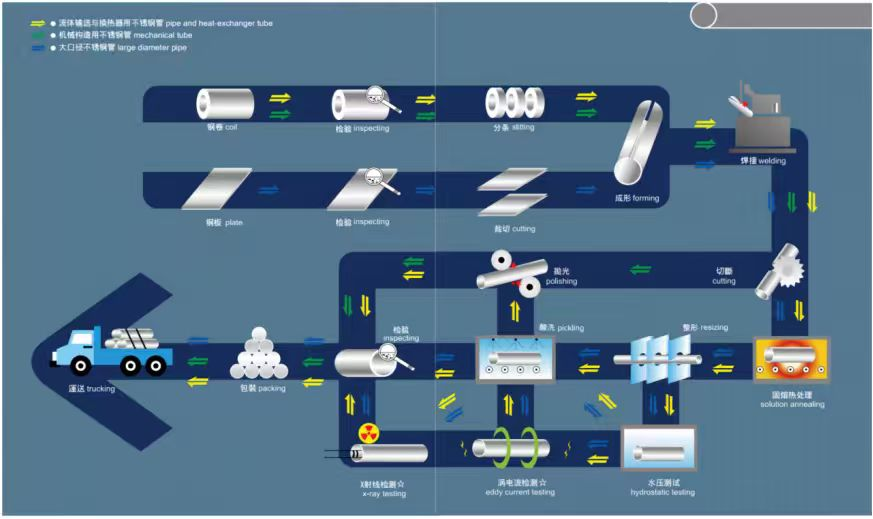
Quality Control & Testing Procedures for ASTM A312 TP347/TP347H Welded Stainless Steel Pipe
| Stage | Inspection Method | Purpose |
| Raw Material | Chemical Analysis (OES) | Verify TP347 composition (Nb ≥ 10×C, Cr 17-19%, Ni 9-13%) |
| Raw Material | Tensile Testing | Verify yield ≥ 205 MPa, tensile ≥ 515 MPa |
| Raw Material | Niobium Recovery Test | Ensure niobium not oxidized during melting |
| In-Process (ERW) | Weld Seam Monitoring | Real-time weld quality control |
| In-Process | Dimensional Inspection | Monitor OD, WT |
| Weld Zone (ERW) | Eddy Current Test (100%) | Detect weld discontinuities |
| Weld Zone (EFW/LSAW) | 100% Ultrasonic Testing (or PAUT) | Detect lack of fusion, slag, porosity |
| Weld Zone (EFW/LSAW) | Radiographic Testing (Class 1,3,5) | Verify weld penetration and quality |
| Weld Zone | Dye Penetrant Test (PT) | Surface crack detection |
| After Solution Annealing | Hardness Test | Verify proper heat treatment |
| Finished Pipe | Hydrostatic Test (Mandatory) | Pressure integrity – 85-100% SMYS |
| Finished Pipe | Flattening Test (for ERW) | Verify weld ductility |
| Finished Pipe | Flange Test (for ERW) | Expand pipe diameter to check weld integrity |
| Finished Pipe | Intergranular Corrosion Test (Practice E) | Detect sensitization – mandatory for TP347 qualification |
| Finished Pipe | PMI (Positive Material Identification) | Confirm grade and Nb content |
| Finished Pipe | Visual & Surface Inspection | Check for surface defects, heat tint |
| Finished Pipe | Marking Verification | Permanent marking per ASTM A312 |
Optional Tests for Critical High-Temperature Service:
Elevated temperature tensile test (e.g., at 650°C)
Creep and rupture testing (long-term)
Grain size measurement (ASTM E112) – TP347H typically ASTM 5-7
High-temperature oxidation test
Primary Applications – ASTM A312 TP347/TP347H Welded Stainless Steel Pipe
Refinery catalytic reformers (Platforming units): Heater tubes and transfer lines operating at 500-700°C with hydrogen atmosphere. TP347 is standard for reformer service.
High-temperature chemical processing: Handling hot hydrocarbons, steam, and hydrogen at temperatures above 550°C where TP321 may have insufficient creep strength.
Superheater and reheater tubes: Fossil fuel power plants and heat recovery steam generators (HRSG) requiring high creep strength.
Heat exchangers: Shell and tube heat exchangers with hot hydrocarbon or hydrogen service at elevated temperatures.
Nitric acid plant piping: TP347 has excellent resistance to nitric acid at elevated temperatures (superior to 304L).
Thermal oxidizers and incinerators: Ducting and stacks handling hot combustion gases up to 900°C.
Furnace components: Radiant tubes, muffles, and retorts in heat treating furnaces.
Petrochemical reactors: Reactor internals and outlet piping for high-temperature processes.
Packaging & Shipping – ASTM A312 TP347/TP347H Welded Stainless Steel Pipe
Packaging for Stainless Steel Welded Pipes:
Anti-corrosion protection: Pipes are oiled or coated with VCI paper. For high-temperature service, no oil residue is preferred (plastic wrap only).
End caps: Heavy-duty plastic end caps protect beveled ends.
Bundling (Small diameters): Bundles with steel straps and interleaving paper.
Individual packaging (Large diameters): Plastic film wrap with end caps.
Wooden crates: For critical grades, custom wooden crates used.
Shipping:
Containers for ≤ 610mm, break-bulk for larger diameters, flat racks for extra long lengths.
Documentation: MTC 3.1/3.2, hydrotest report, eddy current/UT reports, PMI report, IGC test report (if specified), dimensional report, packing list, COO.
Womic Steel Advantages & FAQ – ASTM A312 TP347/TP347H Welded Stainless Steel Pipe
Why Partner with Womic Steel for TP347 Welded Pipe?
Complete Range of Sizes: ERW 1/4″ – 24″, EFW/LSAW 8″ – 60″.
Full solution annealing (1050-1100°C) with water quench.
Intergranular corrosion testing per ASTM A262 Practice E available.
TP347H (high carbon) for elevated temperature creep strength.
Global Certification: ISO 9001, PED (CE), EN 10204 Type 3.2.
Competitive lead times: 25-35 days for ERW, 35-50 days for EFW/LSAW.
Frequently Asked Questions (FAQ) – ASTM A312 TP347/TP347H Welded Stainless Steel Pipe
Q: What is the difference between TP347 and TP321 for high-temperature service?
A: TP347 uses niobium (columbium) stabilization while TP321 uses titanium. TP347 has better creep strength at elevated temperatures (above 550°C) and is the standard for catalytic reformer heater tubes. TP321 is more common for lower stress applications. TP347 also has better resistance to polythionic acid stress corrosion cracking. For temperatures above 650°C, TP347H is preferred.
Q: What is TP347H and when should it be used?
A: TP347H has higher carbon content (0.04-0.10% vs ≤ 0.08% for TP347) and is specifically intended for elevated temperature service where creep strength is important. It has higher allowable stress values in ASME Section I and VIII for temperatures above 550°C. Use TP347H for thick wall sections, superheater tubes, and fired heater radiant coils.
Q: Is solution annealing required for TP347 welded pipe?
A: Yes, ASTM A312 requires solution annealing for TP347. The heat treatment dissolves niobium carbides formed during welding and ensures niobium is available to combine with carbon during service. Typical solution annealing temperature: 1050-1100°C, followed by rapid cooling (water quench). Womic performs full solution annealing on all TP347 pipes.
Q: Can TP347 be welded without post-weld heat treatment?
A: Yes. TP347 is designed to be used in the as-welded condition without post-weld heat treatment. The niobium stabilization prevents sensitization in the weld heat-affected zone (HAZ). For field welding, no PWHT is needed, making TP347 attractive for refinery turnarounds and field fabrication.
Q: What is the maximum service temperature for TP347?
A: TP347 has good oxidation resistance up to 900°C in air (intermittent service). For continuous service, 870°C is typical. For pressure-containing applications, allowable stress values per ASME B31.3 go up to 815°C (1500°F) for TP347. For temperatures above 650°C with high stress, TP347H is recommended.
Q: Do you provide intergranular corrosion testing?
A: Yes. We perform ASTM A262 Practice E (copper sulfate-sulfuric acid) to verify resistance to sensitization. This is mandatory for many refinery and petrochemical applications. Testing is available with third-party witness.
Q: What is the typical lead time for TP347 welded stainless steel pipe?
A: 25-35 days for ERW (small to medium diameters), 35-50 days for EFW/LSAW (large diameters). TP347H may require longer lead time due to specialty plate availability. Intergranular corrosion testing adds 7-10 days. Third-party inspection adds 7-14 days.
Project Reference – Midwestern USA Catalytic Reformer Heater Tube Replacement
Country: United States (Indiana, Midwest refinery)
Standard & Grade: ASTM A312 TP347H (welded)
Dimensions & Quantity:
OD 88.9mm (3″) × Schedule 80S (7.62mm WT) – 800 meters (approx. 18 tons) – ERW process
OD 114.3mm (4″) × Schedule 80S (8.56mm WT) – 500 meters (approx. 16 tons) – ERW process
OD 168.3mm (6″) × Schedule 80S (10.97mm WT) – 200 meters (approx. 13 tons) – EFW process
Total: 1,500 meters, approx. 47 tons
Specifications: ASTM A312 TP347H solution annealed and pickled, beveled ends. Hydrostatic testing. 100% UT for EFW pipes, eddy current for ERW. PMI on every pipe. Mandatory intergranular corrosion test per ASTM A262 Practice E (no attack). Creep rupture test at 650°C (1000 hr minimum, achieved no rupture). Radiographic testing (100%) for EFW pipes. Third-party inspection by TÜV USA.
Application: Replacement of catalytic reformer (Platforming unit) heater tubes in a Midwest refinery. The unit operates at 650-700°C with hydrogen-rich atmosphere (70% H₂, 20% hydrocarbons, 10% other gases). Operating pressure 3.5 MPa. The previous tubes (TP321) failed after 12 years due to creep deformation and carburization. TP347H was selected for its superior creep strength and carburization resistance.
Technical Challenges & Solutions:
Creep strength at 650-700°C – TP347H with carbon content 0.06-0.08% and grain size ASTM 5-6 provided enhanced creep rupture strength. Womic performed elevated temperature tensile test at 650°C: yield 110 MPa, tensile 270 MPa. Creep rupture test (1,000 hr at 650°C, 60 MPa) showed no rupture. The client accepted the material.
Carburization resistance in hydrogen atmosphere – Hydrogen atmosphere at high temperature can cause carburization, reducing ductility. Niobium stabilization in TP347H prevents carbide precipitation along grain boundaries. Womic performed carburization test (exposure to 5% CH₄/95% H₂ at 650°C for 500 hr). Weight gain was 0.2 mg/cm², well below client's limit of 0.5 mg/cm².
Weld oxidation and heat tint control – Field welding of TP347H requires backing gas (argon) to prevent internal oxidation. Womic provided mill-annealed pipes with clean bevels and suggested welding procedure: GTAW root pass with argon backing, followed by SMAW fill (ER347 filler). We supplied 30 weld coupons for procedure qualification. All coupons passed radiographic and PT inspection.
PMI verification for TP347H vs TP347 – The client required 100% PMI to confirm carbon content (TP347H has 0.04-0.10% C vs TP347 ≤ 0.08%). Womic performed XRF plus carbon analyzer on every pipe. All pipes passed with carbon range 0.06-0.08%.
Large diameter 6″ pipe straightness for alignment – The 6″ EFW pipes required straightness of 1.5mm per 3m for flange alignment. Womic used a 4-roll straightening machine. Final straightness achieved 0.8-1.2mm per 3m.
Logistics to active refinery (turnaround schedule) – Heater replacement scheduled during a 4-week turnaround. Womic delivered all 47 tons in a single shipment 10 days before turnaround start. Just-in-time delivery allowed immediate installation.
Result: The catalytic reformer was successfully restarted after turnaround. After 24 months of operation, inspection showed no creep deformation, no carburization, and no cracking. The client has standardized on TP347H for all reformer heater tube replacements across their refineries. Womic Steel is now a preferred supplier for this refinery's high-temperature stainless piping needs.
Contact:
Website: www.womicsteel.com
E-mail: sales@womicsteel.com
Tel / WhatsApp / WeChat:
Victor: +86 15575100681
Jack: +86 18390957568
Womic Steel – Your reliable partner for ASTM A312 TP347/TP347H welded stainless steel pipes for catalytic reformer service, high-temperature refinery, petrochemical, and power generation applications worldwide.
Related Products
-

ASTM A691 1.25Cr CL22 EFW Steel Pipe: Manufactu...
-

ASTM A691 1Cr CL22 EFW Steel Pipe: The Entry-Le...
-

ASTM A671 EFW Steel Pipe: Complete Grade Guide ...
-

ASTM A691 2.25Cr CL22 EFW Steel Pipe for High-T...
-

ASTM A671 CC70 CL22 EFW Steel Pipe: Manufacturi...
-

ASTM A691 5Cr CL22 EFW Steel Pipe for Refinery ...
-

ASTM A671 CC65 CL22 EFW Steel Pipe: Manufacturi...
-

ASTM A691 9Cr CL22 EFW Steel Pipe for Power Pla...
-

ASTM A671 CC60 CL22 EFW Steel Pipe: Manufacturi...